.png)

Num. 66 SECOND QUARTER
Vol. 17 No. 2 (2020)

Núm 65 FIRST QUARTER
Vol. 17 No. 1 (2020)
Francesco Sandulli, UCJC Business & Society Review Director, 31 March 2020,
Dear readers, I present to you the 65th (first quarter of 2020) number of UCJC Business & Society Review.
The world is moving into a deep recession caused by the health crisis triggered by the spread of Covid-19. The innovation capacity of the industrial structure will be one of the main foundations of the future economic recovery. Measures to strengthen this innovation capacity should take into account that there is no a single innovation process, but innovation is a diverse and contingent process to specific places and times.
The next two issues of UCJC Business & Society Review will focus on the diversity of innovation. Innovation is often addressed from a very monolithic perspective that forgets the different contexts in which innovation processes occur. Contrary to the approach of many academics and corporations, there is not a single process of innovation, but innovation actually develops on the basis of very heterogeneous resources, cultures, political systems, processes and tasks that make a process of innovation in one place and time hardly replicable in another different place and time.
This contingent vision of innovation will be studied in numbers 65 and 66 of UCJC Business & Society Review. In this issue, Professor Hilpert raises the elements on which the study of the diversities of innovation should focus such as products, markets for such products, workforce and skills, the structure of the supply chain, the branding of innovation locations and the process of change of existing skills and the duration of such processes. Professor Scherrer describes the nature and phases of innovation's long-wave processes and how developed economies are at the gates of the sixth long wave of innovation. In his article, Professor Scherrer explains the implications of this new long wave, starring technologies related to Industry 4.0, and its complementarities and divergences with the earlier wave characterized by the technologies of the information and communication. Professor Hickie addresses innovation within supply chains through the study of the automotive and aerospace industries. This research addresses the problem of where in the supply chain to innovate and when innovation should be promoted to optimize the relationship between risk and innovation capacity. Finally, Vassiliadis and Hilpert face the challenge of heterogeneous skill-sharing and discuss alternatives to promote a matching between workers' skills and productive structures that nonetheless overcome the problem of agglomeration skills in very specific locations.
I would like to end this letter by expressing a sincere and deep appreciation of UCJC Business Society Review's editorial team to all professional groups that are working tirelessly to overcome the current global health crisis: Thank you!

Num 64 (2019) FOURTH QUARTER
Vol. 16 No. 4 (2019)
Francesco Sandulli, UCJC Business & Society Review Director, December 30, 2019,
Dear readers, I present to you the number 64 (fourth quarter of 2019) of the journal UCJC Business & Society Review.
Professor Corrás from the University of Coruña demonstrates that foreign banking tends to be located in Spanish provinces with greater financial market and international exposure. The work explains that the great recession has led to an increase in the presence of foreign banking in Spain, mainly due to the inflow of Venezuelan capital into the ownership of banks in Spain.
Researchers González-Mohíno and Donate from the University of Castilla-La Mancha demonstrate with a case study as in a traditional sector such as construction it is possible to develop innovation strategies based on proper knowledge management, provided they are supported by determined leadership, a culture that supports innovation and an adequate structure of Information Technologies.
Professors Lozano, Sánchez-Marin and Baixauli from the University of Murcia, perform a very accurate analysis of the effectiveness of Say-on-Pay in Spain by considering the specific evolution of the degree of remuneration alignment between 2011 and 2018, observing that after the implementation of the SOP, the remuneration received by CEOs is increasingly close to the efficient remuneration. It could therefore be said that the SOP is an effective mechanism in Spain to reduce the inefficient remuneration received by CEOs and to increase their linkage to organizational outcomes, as expected by the legislator with its incorporation into corporate governance regulations.
Finally, Professors Marín, Gil and Ruiz of the University of Valencia note that sustainability in retail commercial distribution is built through actions that involve economic sustainability, environmental sustainability and social sustainability. Customers perceive sustainability actions differently according to the retail format. Hypermarket customers value sustainability actions implemented by hypermarkets, while discount store customers don't give as much importance.

Num. 63 (2019) THIRD QUARTER
Vol. 16 No. 3 (2019)
Dear readers, I present to you the number 63 (third quarter of 2019) of the journal UCJC Business & Society Review. In this issue professors Benito Esteban, García Rodríguez and Romero Merino of the University of Burgos note the advancement of the levels of transparency of Non-Governmental Organizations for Development in Spain. The authors analyze the information provided by 76 Spanish Non-Governmental Organizations for Development and come to see that there are a number of factors that favor the transparency of NGOs such as the legal form, being more transparent associations than foundations, the volume of economic resources, their international activity, their links with religious entities or the number of directors.
Professors Cuervo Carabel, Orviz Martínez and Arce García of the International University of La Rioja show the usefulness of a series of tools to measure Corporate Social Responsibility (CSR) on social networks. Specifically in this case, researchers have analyzed how companies use the social network Twitter to reinforce their communication strategies linked to the CSR. The results indicate that most Spanish companies are not adequately harnessing the potential of social media and are far from becoming influencers. In addition, the authors confirm that social media communication of CSR actions can be very useful in creating positive perceptions about the company. However, the study concludes that companies today focus excessively on communicating the specific action of CSR, but fail to communicate the association of that action to broader values and concepts such as sustainability, responsibility, commitment, value, willfulness that are the ones that really contribute to creating positive feeling in society.
Outside the scope of the RSC in the strict sense, the following two papers published in this issue focus on companies' human resources strategies. Researchers Guinot and Barghouti from the Jaume I University of Castellón use data from the National Working Conditions Survey to study how trust in workers improves worker commitment levels and motivation. This work provides empirical evidence that suggests that managers who want to improve the commitment and motivation of their employees should opt for leadership styles either altruistic or inclusive, as opposed to other more formal and hierarchy-based leadership styles. In the fourth work of this issue, Professors Buil, Catalán and Ortega of the University of Zaragoza explain how to build gamification tools in the recruitment process in order to increase the motivation of candidates to join the company. The results of the study suggest that companies should build gamification tools for talent recruitment in such a way that they make candidates feel competent and autonomous. Competency is achieved through realistic challenges in the selection process, while autonomy is achieved through games that are flexible enough not to restrict the decision-making capacity of the candidates. In addition, the work shows that companies that use gamification appropriately in the recruitment process significantly reinforce the perception of candidates of the brand identity of the company, being an interesting tool of building employer branding in the future.

N 62(2019): SECOND QUARTER
Vol. 16 No. 2 (2019)
With great pleasure I present to you the number 62 (second quarter of 2019) of the UCJC Business & Society Review. In this number the professors Ferreras, García, Olmos and Alegre from the University of Valencia study how companies can build technological capabilities and marketing capabilities from Open Innovation strategies. The authors pay special attention to the nature of partners and demonstrate that marketing capabilities are developed through Open Innovation strategies focused on industrial partners (competitors, suppliers and customers) while technological capabilities are developed not only by cooperation with industrial partners but also with non-industrial partners. Also from the University of Valencia, Professors Pla and Villar with the cooperation of the CEO of Royo Group, analyze the transformation strategy of the Royo Group company, as an example of good practice of innovation, internationalization and evolution of the strategic focus from product centric to customer experience centric. The third article is the result of the international scientific collaboration by which professors Gallego and Di Meglio of the Complutense University of Madrid, Rubalcaba of the University of Alcalá de Henares and Vanska of the University of Vaasa describe through several case studies how Spanish companies in the tourism sector, although they carry out some activities involving the customer in the design of new services, are still far from using techniques that allow them a deep understanding of the customer needs that will lead to a more efficient development of new services. Finally, professors Sotelo and Sierra of the Complutense University show how an important part of the media sector in Spain has evolved from family controlled businesses to companies controlled by financial institutions and investment funds. The authors raise interesting reflections on the independence of editorial lines or the use by financial institutions or investment funds of the media companies that they control to create favorable opinion streams in society challenges that affect them. Prof. Dr. Francesco D. Sandulli Director of UCJC Business & Society Review
Published: 2019-06-30

Num. 61 (2019): FIRST QUARTER
Vol. 16 No. 1 (2019)
With great pleasure I would like to present to you the number 61 (first quarter of 2019) of the UCJC Business & Society review. This issue continues to fulfill the objective initiated by Universia Business Review to transfer excellent research to society and productive system in Spain and Latin America. However, this number also starts to take firm steps to expand the audience and the fields of study that are discussed in the journal, in order to reinforce the original, critical, curious and above all interdisciplinary analysis that UCJC BSR aims to make of the challenges and problems of our times through rigorous scientific research in Management, Economics and Social Sciences in general.
Thus, in this issue the journal addresses through the work of Eleuterio Vallelado (University of Valladolid) and Javier Villar (University of Santiago de Compostela) the study of the paradox of the Single Monetary Policy of the European Central Bank, which far from homogenizing financial markets produces heterogeneous effects on the lending policies of banks in the different EU states. In this way, this research notes that the existence of significant differences in terms of characteristics of borrowers, loans and prices distort the effect of the Single Monetary Policy and produce significant differences in conditions for access to lending in the various countries of the European Union which will have a decisive influence on the competitiveness of the firms in different countries.
Within the scope of finance, UCJC BSR analyzes in this issue through to the research of Diego de Mingo and Juan Carlos Matallín-Sáez of the University Jaume I of Castellón the different results of the active investment funds and the funds that replicate to a reference index in the United States. Research shows that the financial crisis has changed the differences between these two types of fund. Whereas, prior to the financial crisis, low-turnover funds yield higher gross returns than those obtained by index funds, and high-turnover funds obtained similar gross returns or even worst. After the financial crisis, the gross results of low-turnover active funds matched the gross returns of the funds that replicate an index. However, in terms of net returns, funds that replicate an index get better results due to lower commissions.
UCJC BSR provides very interesting data relating to the internal brand strategies of Spanish universities through the article by Professors Javier Casanoves Boix of the International University of Valencia, and Inés Küster Boluda and Natalia Vila López from University of Valencia. These professors analyze how professors and researchers perceive the brand of their universities and observe that in the private university there is better perception of the brand in the postgraduate studies, while in the public university there is a better perception of undergraduate and doctoral studies. Private university workers also have a better perception of the trust and service received, the value, the needs and respect for the institution, despite a perception of greater labor instability. The authors advocate for the need to create initiatives aimed at building greater team spirit and feeling of belonging in public universities.
Finally, sociologists Alfonso Unceta (University of the Basque Country) and Xabier Barandiaran (University of Deusto) make an interesting contribution on the link between public innovation and social innovation, in which they build a new paradigm of the public innovation based on cooperative and experimental governance, which can and should be supported by dynamics and previous experiences already developed from the perspective of social innovation. However, they also raise the paradox that these initiatives, although initiated by the Administration to survive in time, require that citizens perceive sufficient distance from the Administration itself.
Prof. Dr. Francesco D. Sandulli
Director of UCJC Business & Society Review
FOURTH QUARTER 2018. 60
Vol. 15 No. 4 (2018)
CSR communication is necessary but it remains a challenge because of the potential scepticism that it can provoke in audiences. In the first article, María del Mar García-De los Salmones y Andrea Pérez (Universidad de Cantabria) analyse consumer reactions – in terms of beliefs (attributions), affects (emotions and attitudes) and behaviour – to CSR advertisements of financial entities with different social reputations. As a result, it was observed that reputation is a key variable, it explains differences in audience reactions, and it may condition the effectiveness of advertising.
Professors Mónica Herrero Subías, Mercedes Medina Laverón (Universidad de Navarra), y Alicia María Urgellés Molina (Universidad de los Hemisferio), in the next article, study the value that different online audiovisual services give to the recommendation systems. The authors analyze three services currently operating in Spain: Atresmedia, Movistar + and Netflix. A set of criteria is proposed to compare the recommendations present in each platform and the use that companies make of them. The results show that the audiovisual services have implemented the recommendations to a different extent according to their business model and their main activity.
In the next article, Teresa Vallet-Bellmunt (Universitat Jaume I de Castelló) y Pilar Rivera-Torres (Universidad de Zaragoza) study the relationships between Marketing and Logistics Performance in a context of inter-organisational integration to search for differences between Manufacturers and Distributors. The information has been provided by 450 companies in the Spanish construction materials sector. The results obtained show the importance of the Logistics Service as an instrument to improve the Relational Performance of the integrated company and the different paths that Manufacturers and Distributors take to increase short- and long-term Marketing Performance.
All the potential users interested in getting online television at home need information to make decisions and to face the existing offer. The major platforms providing services in Spain are Amazon Prime Video, Filmin, HBO, Movistar Plus, Netflix, Rakuten TV and Sky. Each of these platforms has its strengths and weaknesses. In the last article professors Sheila Liberal Ormaechea (Universidad Francisco de Vitoria) y Francisco Cabezuelo Lorenzo (Universidad Complutense de Madrid) have reviewed variables such as the price of the subscription, the catalog, online and offline use, image quality (Full HD, Ultra HD or other options), use of simultaneous screens and own production of contents to help to make a decision
I encourage you to read all the articles. We hope to continue to have everyone's trust: Associate Editors, members of the Scientific Committee, Editorial Board, evaluators, author-collaborators, companies and above all the readers from both the University and the business world.
THIRD QUARTER
No. 59 (2018)
In the first article, professors Diego Víctor de Mingo-López and Juan Carlos Matallín-Sáez (Universidad Jaume I) compare the performance of actively-managed mutual funds and index funds. For a large sample of US domestic equity share-class funds, we analyze the relation between portfolio turnover and fund risk-adjusted return. Using gross returns, results indicate that before (after) the onset of the recent financial crisis, low-turnover active funds reach higher (similar) results than those obtained by index funds, whilst high-turnover active funds have similar (worse) returns to index funds. For the authors the same evidence is found when net returns are considered, but index funds perform comparatively better due to their lower costs. From an investors’ perspective, investing in previous high-turnover funds could lead to lower overall risk-adjusted returns.
The relationship between family-firm status and internationalization strategy has been widely discussed in the family business literature. However, for the professors Rosario Andreu, Enrique Claver, Diego Quer and Laura Rienda (Universidad de Alicante), prior studies did not address this topic in the case of the Spanish hotel industry, even though this being a highly internationalized sector with a high proportion of family firms. For this reason, the aim of the study is to examine whether the family character of Spanish hotel chains has conditioned their internationalization strategies. For the authors, the results show that positive aspects possibly prevail in Spanish family hotel chains which encourage these enterprises to commit themselves more strongly to internationalization and to adopt riskier growth strategies
Despite the benefits of entrepreneurial activity on economic development, entrepreneurs do not have a good social status in all societies. While in some countries they are highly respected (Anglo-Saxon context), in others, their image is not so positive (European context). In this paper, professors Lucio Fuentelsaz, Juan P. Maícas (Universidad de Zaragoza) and Javier Montero (Universidad de Deusto) highlight these differences using a sample from the GEM project and explain the social status of entrepreneurs using the cultural profile of countries, which is measured with the Schwartz database. Theirs results show that some cultural profiles favor entrepreneurs’ social status.
Today, many organisations believe that it is essential to evaluate jobs. If this is so, what is the most appropriate method for my organization? Is one that has been designed ad hoc better or a commercial one? To answer these questions, professors Francisca Berrocal Berrocal, Miguel Aurelio Alonso García, and Raúl Gonzalo Ramírez Vielma (Universidad Complutense de Madrid) examine whether differences exist when classifying and ordering jobs according to the evaluation method used, in order to provide recommendations that will make it easier for human resources departments to make decisions and ensure success in the application of the results.
I encourage you to read all the articles. We hope to continue to have everyone's trust: Associate Editors, members of the Scientific Committee, Editorial Board, evaluators, author-collaborators, companies and above all the readers from both the University and the business world.
SECOND QUARTER
No. 58 (2018)
Through this letter we would like to inform you that this issue of Universia Business Review will be the last one published by Universia. But this does not mean that the journal will cease to be published. From the next issue onwards, the University Camilo José Cela will be in charge of the journal's publication. We know you are looking forward to this new challenge and will do your best to improve and position the journal where it deserves to be.
We would like to thank Universia for the opportunity it provided to the academic community with the creation of Universia Business Review. Since the first issue was published in February 2004, 58 issues and one special issue (Banco Santander 150th anniversary) have been published, faithfully observing the frequency and guaranteeing the internationally recognised principles of editorial quality. UBR became the first Spanish business management publication to be indexed in the main international repositories and databases (Web of Science and Scopus) and be a reference for the Spanish and Latin American academic community. Since 2009, UBR has had the journal excellence seal awarded by the Spanish Foundation for Science and Technology (FECYT) as a scientific journal of proven quality.
Since Universia informed the Management Committee that the publication of the journals did not feature among its new strategic direction, we have tried together to find a way to at least carry on with the long-established legacy. But above all, a new publishing company should ensure that the journal not only continues to be published to the required level of quality and standards, but that it also guarantees the journal's future. For a few months now, Universia and the University Camilo José Cela (UCJC) have been working closely together to ensure that the transfer is carried out in the friendliest manner, causing the least possible disruption to day-to-day operations. This transfer would not have been possible without the good work of the General Director of the Universia Foundation, the Rector of the UCJC, as well as the Director of Digital Marketing, Channels and Content of Universia and the UCJC's Vice Rector of Innovation.
For this reason, we want to convey a message of tranquillity and continuity and we will continue to receive, review and accept articles as we have been doing up to now. For a period of time the current Management Committee will continue to function to facilitate the integration of the new publishing company until a new Committee is appointed. Even if the publishing company changes, the journal will continue to be indexed in the main international repositories and databases where it is currently located. All the articles will be transferred and as we have mentioned, there will be no interruption to our editorial work.
In the first article, professors César Zarza‑Herranz, Félix J. López‑Iturriaga, from the University of Valladolid, and Nuria Reguera-Alvarado (University of Seville) analyse the relationship between some of the personal characteristics of the members of the audit committee of Spanish listed companies and results-based management. For the authors, the results show a non-linear relationship with seniority on the board: while in the early stages a longer duration can compromise the independence of the directors, there comes a point when seniority on the committee increases their experience. Being part of an overly high number of boards results in less ability of the directors to detect results-based management. Higher educational qualifications and more diverse professional experience contribute to improving the quality of financial information.
The dissatisfaction of workers has a great impact on organisations and can have a direct effect on profitability and quality of the goods or services provided. Professors Montserrat Crespi-Vallbona and Oscar Mascarilla-Miró (University of Barcelona) analyse different variables that determine well-being at work. Based on a survey of 4207 IT professionals, this article examines the importance of job content, team climate, leadership, recognition and compensation, physical working conditions and personal working conditions as key aspects of employee satisfaction. The results conclude that the job description is the first aspect that employees value in their satisfaction rate. Physical working conditions and leadership are the least significant variables.
Multiple national and international rankings select a subset of companies in a country or the world as the best to work for. Despite this uniformity, the scores they obtain in the indexes on which the rankings are based are not the same. Professors Francisco Ferreiro Seoane and Celestino García-Arias (University of Santiago de Compostela) try to find out if the differences between the scores obtained by the companies considered the best to work for in Spain can be explained through contextual factors. For the authors, the results of the analysis show that the scores of the companies tend to increase with their size and with value; they differ between autonomous communities and they do not differentiate between nations/economic-cultural areas of origin nor between sectors of activity.
In the following article, Professors Karin Martín-Bujack, M. Teresa Corzo and Isabel Figuerola-Ferretti (Pontificia Comillas University) offer a methodology to form a portfolio of equity investments with exposure to global credit risk and controlled market risk. Following a methodology of factor breakdown, the authors reduce the sample of the largest international companies to a portfolio with only 11 shares, representing different risk factors, which show a high diversification in terms of systematic risk and a risk-return binomial that is comparable to the main international equity indices.
I encourage you to read all the articles. We hope to continue to have everyone's trust: Associate Editors, members of the Scientific Committee, Editorial Board, evaluators, author-collaborators, companies and above all the readers from both the University and the business world. We welcome the Camilo José Cela University as the new publishing company and we are looking forward to this new challenge and are ready to improve the inherited legacy.
FIRST QUARTER
No. 57 (2018)
Universia Business Review begins its fifteenth year faithfully fulfilling its publication intervals and confirming its internationally recognised principles of editorial quality. We would like to emphasise the Editorial Committee’s commitment to continuing to be indexed in the main international databases (Web of Science and SCOPUS) and ensuring that UBR reinforces its reputation as a scientific journal of proven quality.
As always in the first issue of the year we would like to express our sincere thanks to the associate editors and academics for their excellent work as assessors. They are the finest formal guarantee of the soundness of the articles we publish and ensure that our demanding standards are maintained. In 2017 we received 100 articles, of which 16.1% of those submitted for evaluation were published.
In the first article Pablo de Andrés, Iñigo García-Rodríguez (Universidad Autónoma de Madrid), María Elena Romero-Merino and Marcos Santamaría (Universidad de Burgos) present an in-depth study of the politicisation and financial knowledge-experience of the boards of directors of Spanish savings banks. To do so, they have built up a database of biographical information on the directors involved for the period 2004-2010. The results of the cluster analysis reveal that the boards can be divided into four groups based on the degree of politicisation and financial expertise of their members. They reach the conclusion that the banks with the highest levels of financial expertise on their boards also achieve the highest levels of financial solvency.
An innovative attitude as the driving force behind the environmental strategy has been well proven in the literature on environmental management. In the following article Inés Suárez-Perales, Pilar Rivera-Torres and Concepción Garcés-Ayerbe (Universidad de Zaragoza) analyse this relationship by studying how the development of an advanced or proactive innovative attitude, characterised by implementation of innovation practices beyond the usual practice in the sector, affects the environmental strategy. The authors note that companies with a proactive innovative strategy are far more capable of achieving proactive positions in the implementation of their environmental strategy. This leads them to conclude that proper development of the innovative capacity enables them to harness resources and accumulate experience and knowledge that help them to take up proactive positions in their environmental strategy.
The goal of the next article is to study the effect of distance between countries on selection of the country of destination. In particular, Beatriz Domínguez (Universidad CEU San Pablo), Jaime Gómez (Universidad de La Rioja) and Juan P. Maícas (Universidad de Zaragoza) make use of two dimensions of the distance between the country of origin and that of destination to explain entry into foreign markets: (1) the geographical dimension and (2) the existence of historical ties. Taking the mobile telecommunications industry as a reference, the authors provide a three-stage approach composed of an in-depth descriptive study, an empirical analysis and presentation of three paradigmatic cases in the sector. They conclude that companies are more likely to enter countries at smaller geographical or historical distances from their own and that historical ties positively moderate the relationship between geographical distance and entry.
In the last article Ana Mol-Gómez-Vázquez (Universidad de Almería), Ginés Hernández-Cánovas and M. Camino Ramón-Llorens (Universidad Politécnica de Cartagena) analyse the explanatory factors behind discouragement of borrowers in a sample of SMEs that operate in an economy dominated by banks. The results show that pronounced informational asymmetries and loan application costs increase the probability that the borrower, especially smaller companies and those that work with fewer banks, will be discouraged from applying for loans. The authors also conclude that companies whose managers have a proactive attitude to growth and business improvement are less likely to be discouraged from such requests.
I encourage you all to read all the articles. We hope to continue being worthy of your trust during the coming year. Associate Editors, members of the Scientific Committee, Editorial Board, assessors, author-collaborators, companies and especially the readers, both from the universities and from the business world.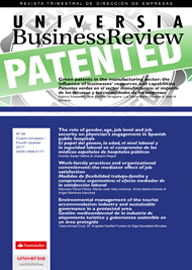
FOURTH QUARTER
No. 56 (2017)
In the first article, Sabina Scarpellini, Pilar Portillo-Tarragona (UniversityofZaragoza), Luz María Marín-Vinuesa (UniversityofLa Rioja) and José M. Moneva (UniversityofZaragoza) aim to provide professionals with an analysis of manufacturing sector companies with green patents, associating their financial-economic characteristics with their number of national and European green patents. They especially analyzed the relation between collaboration with R&D centers and holding patents. The results, obtained through an ad hoc database of 1,606 Spanish companies, indicate that the collaborative capacity for R&D provides a useful explanation for Spanish manufacturing companies holding green patents. In addition, the companies’ financial performance, maturity and size are considered relevant for the development of green patents.
For professors Andrés Salas-Vallina and Joaquín Alegre (UniversityofValencia) the goal of their article is to analyze how the variables of age, gender, job status and job security affect employees’ job commitment, and our goal is to provide new evidence. A sample of 167 doctors specializing in allergology was analyzed. The results help clarify the contradictions found in prior research, as they show that age does not affect job commitment; while gender, job status and job security are variables that do.
In the following article, Manuela Pérez-Pérez, María-José Vela-Jiménez, Silvia Abella-Garcés and Angel Martínez-Sánchez (UniversityofZaragoza) analyze whether job satisfaction has a mediating effect among the availability of work-family reconciliation measures and employees’ organizational commitment. The study data was obtained from a sample of 322 employees from Spanish companies which were recently given the “Flexible Company Award” or are certified as a “Family Friendly Company”. The authors conclude that employees are more satisfied with their job when they perceive that they can truly rely on work-family measures to balance their professional and family lives, and this satisfaction also has a positive impact on their organizational commitment.
In the final article, Yaiza Armas-Cruz, M. Ángeles Sanfiel-Fumero and Olga González-Morales (UniversityofLa Laguna), analyze the environmental management of the hotel industry and its relation with governance of a mass destination constrained by its consideration as a protected area (Biosphere Reserve). For a sample of 94 establishments in Fuerteventura (Spain) the authors determine the level reached by their environmental protection and their driving and obstructing factors. They conclude by identifying the differences between hotel and extra-hotel infrastructure, contributing to the definition of a sustainable tourism governance model based on public-private coordination.
I encourage you to read all the articles. This year we hope to continue to earn the trust of everybody: Associate Editors, members of the Scientific Board, Editorial Board, evaluators, authors-collaborators, businesses and above all readers, both from the University and the world of business.
THIRD QUARTER
No. 55 (2017)
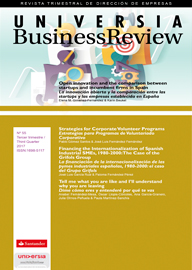
In the first article, Professors Elena M. Gimenez-Fernandez (Complutense University of Madrid) and Karin Beukel (UniversityofCopenhagen) compare the open innovation strategy between start-ups and established companies over a ten-year period (2004-2013) in a sample of Spanish companies. The authors find that innovation strategies differ considerably, a fact which has implications for business administration. Established companies and start-ups differ in terms of their use of external cooperation activities as a source of innovation. Because start-ups lack financial and human resources, they open their borders to a greater extent than established companies; furthermore, start-ups benefit from being flexible because they have not yet implemented routines. The authors believe that this enhances the result of the start-ups' innovation.
Companies’ lack of awareness of the most effective policies and strategies could be behind their low rates of participation in their Corporate Volunteering programmes. Pablo Gómez Santos and José Luis Fernández Fernández (Universidad Pontificia de Comillas) have attempted to analyse what strategies can be used to effectively implement Corporate Volunteering programmes, based on employees’ motivations for taking part in these kinds of programmes. The authors conducted a qualitative empirical study inSpainto define a model which includes these policies and strategic guidelines, based on the motivations and determining factors for employee participation in Corporate Volunteering programmes.
Professors José Luis García Ruiz (Complutense University of Madrid) and Paloma Fernández Pérez (University of Barcelona) believe that not enough research has been carried out on the role played by funding in the expansion of industrial companies, particularly in small and medium-sized companies (SMEs), which, since the 1980s, have had to cope with the challenges of internationalisation required in the Second Wave of Globalisation. This article is an approach to the problem throughSpain’s case over the 1980-2000 time frame. It offers new information taken from databases and an important case study: it explores the key financial reasons why Grifols has been able to turn itself from a mid-sized company into a large global corporation. According to our research, the way the pecking order works means that large companies steer clear of banks and that there is more bank credit for SMEs. The authors believe that the Grifols case proves that SMEs have easier access to credit if they have a strong international partner on their side.
The increase in employees’ organisational commitment as a way of increasing their yield and bringing down absenteeism, as well as employee rotation, have become key practices in companies. Anabel Fernández-Mesa(UniversityofValencia), Óscar Llopis (Rennes School of Business), Ana García Granero, Julia Olmos Peñuela, and Paula Martínez-Sanchis (UniversityofValencia) propose an innovative perspective, examining issues relating to employees’ personalities. Using the Five-Factor Model (FFM) as a starting point, the authors attempt to understand how each one of these facets has an influence on the employees’ degree of commitment with the organisation, exploring to what degree employees’ personality influences their intention to continue in the company. The authors stress that one of the main practical implications of this study is the empirical verification of the importance of the employee's character as a way of understanding the employee’s degree of commitment.
I encourage you to read all the articles. During the year which is beginning, we hope that all of you will continue to deposit your trust in us: Associate Editors, members of the Scientific Committee, Editorial Council, evaluators, author-collaborators, companies and above all readers from the world of Universities and also the corporate world