.png)
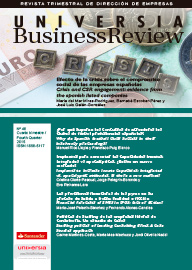
In the first article, professors María del Mar Miras Rodríguez, Bernabé Escobar Pérez and José Luis Galán González of the University of Seville (Universidad de Sevilla) study the impact of the economic crisis and the financial status of businesses on Corporate Social Responsibility actions (CSR) undertaken by Spanish companies listed on the IBEX-35, allowing them to verify the degree of engagement with these types of strategies and initiatives. Based on various theoretical approaches, (the Resource Scarcity and Agency Theory Hypothesis), we analyse changes in CSR and Financial Performance prior to and during the crisis, grouping companies according to these variables. The results show that a large group of companies, the majority of which are characterised by the existence of a leading shareholder, have either maintained a consistent level or increased their social engagement during the crisis.
Manuel Rico Llopis and Francisco Puig Blanco of the University of Valencia (Universidad de Valencia) analyse the reasons behind the extraordinary success of football clubs’ insolvency proceedings. The Spanish insolvency scene has shown very high rates of failure (in excess of 90%). By contrast, the vast majority of football clubs in such circumstances have successfully resolved their legal insolvency situations. According to the authors, the study indicates that such results were made possible by (i) a financial structure with less of a concentration of special privileged credit (particularly secured banks) than other corporate entities and (ii) the systematic support that public administrations have provided them (even adhering to proposals for arrangements).
Technological implants are being developed to increase innate human abilities (implantes tecnológicos para aumentar capacidades humanas innatas - ITACI) such as memory or calculation speed. In order to contrast their acceptance, Cristina Olarte Pascual, Jorge Pelegrín Borondo of the University of La Rioja and Eva Reinares Lara (King Juan Carlos University / Universidad Rey Juan Carlos) have applied a sequential cluster analysis to a sample of 600 individuals, identifying four groups: integrated, semi-integrated, non-integrated and apocalyptic. According to the authors ITACI are considered interesting, especially those that delay aging and improve the speed of thought, although there is much fragmentation with regard to their intended use. These results open a new scenario for insideable technology.
Professors María José Palacín Sánchez and Fernando Alonso Canales of the University of Seville (Universidad de Sevilla) assess the financial forecast process of small and medium-sized companies (SMEs) in their flotation, analysing the quality of the profit forecasts made and exploring the factors that determine the accuracy of such forecasts. The study considers all companies that have been listed on the Spanish alterative investment market, the Mercado Alternativo Bursátil (MAB). The authors believe that the results show that the majority of executives from companies on the MAB have been optimistic and highly inaccurate in their future profits estimates.
In the final article, Carme Martínez Costa, Marta Mas Machuca (International University of Catalonia / Universitat Internacional de Catalunya) and Jordi Olivella Nadal (Polytechnic University of Catalonia / Universitat Politècnica de Catalunya), analyse the staffing policies of leading business consulting companies in Spain in order to identify their characteristic factors and the similarities and differences between them. To do so, they presented a case study on Accenture, IBM and Compañía Z. The results suggest that partnership and management models by professionals continue to be relevant, but are insufficient when explaining different policies. The authors identify five factors that characterise them and the main trends.
I would like to conclude by once again thanking Universia for its trust and the work performed in this last period by the Area Editors, the Scientific Committee, the Editorial Board and the evaluators.
Published: 2015-12-11