.png)
Letter from Editor in Chief
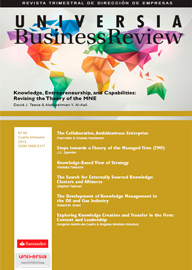
This special issue of Universia Business Review is devoted to the role played by knowledge and innovation in strategic management. ‘Knowledge, Strategy, and Innovation in the firm’ is a special issue in which leading knowledge and innovation management scholars have participated. Some of them are members of the Scientific Cometee of the Nonaka Centre for Knowledge and Innovation of CUNEF Business School in Madrid. This Centre, which was inaugurated in November 2011 by its Honorary President Professor Ikujiro Nonaka, focuses its activities on Knowledge Management, Innovation and Firm Strategy research and training.
This special issue has been possible thanks to the honorary collaboration Professor Ikujiro Nonaka and the work Professors María Ángeles Montoro-Sánchez and Gregorio Martín-de-Castro, both of Complutense University of Madrid, and members of the Executive Board of the Nonaka Centre for Knowledge and Innovation. The Scientific and Executive Boards of Universia Business Review would like to acknowledge the fantastic work done in editing the special issue, contacting the authors and managing the review process and accepting papers that fit the academic requirements of the journal.
The seven articles that comprise this special issue provide theoretical reviews and case studies on the main issues in the debate on the firm’s existence and development: knowledge, innovation, and strategy. These papers address the basis of firm strategy, the important role of innovation and its related sources, as well as the need to further theoretical foundations with new visions, where knowledge is an important element of the firm´s existence and survival. Looking at the content of the special issue, practitioners, entrepreneurs, and managers will have the opportunity to see and verify the value of academic research.
In the first article Professors David Teece of University of California at Berkeley in the US and Abdulrahman Y. Al-Aali of King Saud University in Saudi Arabia, provide a theoretical analysis on the multinational enterprise. Taking the eclectic paradigm as the starting point, the authors explain how the concepts of dynamic capabilities, knowledge management, and entrepreneurship provide a better understanding of the multinational enterprise. The paper concludes with a set of managerial implications for multinational enterprises.
Professors Paul Adler of University of Southern California in the US and Charles Heckscher of Rugters University in the US, propose in the next article a new type of organizational form called collaborative community that enables a firm in a complex and dynamic environment achieve high levels of performance in both exploration and exploitation, achieving ambidexterity performance. The new type of organization –the collaborative model- combines mechanistic and organic organizational forms, requiring a new type of trust –collaborative trust- jointly with a specific set of values, norms and authority system. The authors conclude the paper with the case of the U.S. health company Kaiser Permanente.
Taking the issues introduced in 1937 by Ronald Coase on the existence, limits and coordination mechanisms of firms as the starting point, Professor J. C. Spender of ESADE in Spain, returns to the ongoing debate of these issues among management and economic researchers. He not only provides a criticism but also raises new questions, and highlights the role of context, imagination, and judgment to delimitate and respond to these issues.
The article of Professor Hirotaka Takeuchi of Harvard University in the US, provides a review of current thinking on the Knowledge-Based View of the Firm. Firms differ from each other, not just in business activities, resources and competences, but also in the different visions on the future of the people who decide and implement strategy. It is necessary to take into account all these issues in order to analyze the strategy pursued. This paper explains how the knowledge-based view complements the contributions of the classical schools of thought on strategy and, especially, on aspects related to the role of people as the core of the strategy, the consideration of strategy as a dynamic process, and the firm´s social agenda.
In the next article, Professor Stephen Tallman of University of Richmond in the US, studies alliances and location in clusters as new forms of access to external knowledge. Given that firms are increasingly dispersing their value-added operations around the globe and outsourcing them to alliances, external knowledge sources are becoming increasingly important. This paper reviews the main research topics related to alliance networks, as well as their location in clusters as external sources to access to new knowledge.
Professor Robert M. Grant of Bocconi University in Italy, provides empirical evidence on knowledge management via a multiple case study in the international oil industry. He shows two main ways of understanding and implementing knowledge management in business activities. The paper illustrates on the one hand the application of information and communication technologies in the management of explicit knowledge and, on the other hand, the use of knowledge management techniques to facilitate face-to-face explicit knowledge transfer.
Professors Gregorio Martín-de Castro and María Ángeles Montoro-Sánchez, both of Complutense University of Madrid and Nonaka Centre for Knowledge and Innovation of CUNEF Business School in Spain, propose, review the main theoretical issues on leadership and organizational context. Terms such as distributed or wise leadership, ba, social capital or collaborative context are analyzed and integrated. Finally, this paper proposes a new research framework, called configurational, which emphasizes the study of complex phenomena in social sciences, where causality is rarely presented in isolation, and where the co-joint analysis of causal conditions offer greater explanatory power.
With this special issue we hope that entrepreneurs, managers and scholars find useful the contributions made in each of their areas. This will help the practitioner and academic communities share knowledge on business management, which is key for the development of our society.
I would like to acknowledge the editorial work of Professors María Ángeles Montoro-Sánchez and Gregorio Martín-de Castro, the contributions by the authors of this issue, all worldwide recognized professors and researchers in the field of knowledge, innovation and strategy in the firm, as well as the work of reviewers, who with their generous collaboration have made possible this special issue fulfills the standards required by UBR. I encourage you to read this special issue.
Published: 2014-09-24