.png)
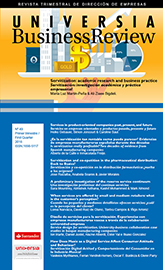
Now in its thirteenth year, Universia Business Review has never been late going to print and has earned international renown for its editorial quality. The Management Committee firmly intends to ensure that UBR remains indexed on the main international databases and continues to be widely seen as a journal of outstanding scientific quality. UBR is categorised as a journal A and is ranked 31 out of the 233 (1/11 in business journals) Spanish publications on the subject of human and social sciences according to Web of Science and/or SCOPUS (ISOC-CSIC). We are currently being reassessed by the Social Science Citation Index and we are confident that before too long the journal will once again be accepted.
This ongoing commitment to quality has earned UBR the badge of EXCELLENT from Fundación Española para la Ciencia y Tecnología (Spanish Foundation for Science and Technology) attached to the Ministry of Science and Innovation (FECYT); enabled it to be indexed on SCOPUS (Elsevier Bibliographic Databases. Scimago Journal Rank 2014 (SJR): 0.230 Q3; Category: Business, Management and Accounting. Position 133 of 236; and last but not least earned it third place out of the 65 Spanish economic journals (h-index of Spanish scientific journals under Google Scholar Metrics, 2010-2014). We encourage authors to send articles that meet the required standards of quality to provide executives and business owners with responses and valuable insight in relation to their own business concerns and problems.
As is customary in the first edition of the year, we would like to express our sincerest gratitude for the hard work of all the associate editors and professors in evaluating the contributions made to the journal during the year, thus guaranteeing the quality and scientific rigour of the articles published in the journal, while proposing improvements to the work and ensuring that our strict requirements are met. In 2015, we received a total of 95 articles, 15.3% of which were accepted after due evaluation.
Issue 49 of Universia Business Review is essentially devoted to the subject of “Servitization: strategy, innovation and impact”. The published articles were submitted in response to the “call for papers” and defended at the 4th International Conference on Business Servitization (ICBS 2015) (November 2015) following a rigorous selection process. The selected articles were then sent to UBR ahead of the start of the editorial review process. The Management Committee wishes to thank the guest editors for their hugely valuable work, namely Professor María Luz Martín-Peña (Universidad Rey Juan Carlos) and Professor Ali Ziaee Bigdeli (Aston University), who were without doubt the driving forced behind this special edition by expertly handling the entire process of editing the published work.
In their editorial for the issue, Professors Martín-Peña (Universidad Rey Juan Carlos) and Bigdeli (Aston University) explain what we understand by servitization and how the concept can help companies become more competitive while bringing them closer to their customers. They review the articles published on the subject of servitization and explain through case studies how they have helped bring the academic community closer to the business world.
The special edition starts with an article by Professors Heiko Gebauer, Simon Joncourt, Caroline Saul (Eawag, Swiss Federal Institute of Aquatic Research), in which the authors discuss the past, present and future of product-oriented services within companies. Alberto de la Calle and Inmaculada Freije (Universidad de Deusto) then attempt to answer the question of whether servitization is really as profitable as it might seem. Jose Ruizalba, Anabela Soares and Javier Morales (University of West London) analyse the servitization process in relation to pharmaceutical distribution and ask if it is returning to its roots. Sara Mountney, Abhishek Asthana and Kashif Mohammed (Sheffield Hallam University) and Mark Almond (B S Stainless) analyse other alternatives, including a services SME that has bucked the trend by developing manufacturing capacity to improve its range of products and services for customers. Lorea Narvaiza, David Ruiz de Olano, Tontxu Campos and Iñigo Arroniz (Universidad de Deusto) focus on how customers perceive the services offered to them by retail companies. Ion Iriarte, Daniel Justel, Alazne Alberdi, Ester Val and Itsaso González (Universidad de Mondragón) investigate the design of services for servitization in manufacturing companies through university-company partnerships. And last but not least, Vasileios Myrthianos (Universidad Politécnica de Cataluña), Ferran Vendrell-Herrero (University of Birmingham), Oscar F. Bustinza (Universidad de Granada) and Glenn Parry (University of the West of England) analyse consumer attitudes and behaviour in the musical industry through digital servitization.
I would encourage you to read all the articles. We hope to continue to inspire the trust of everyone as we move through 2016: associate editors, members of the Scientific Committee, Editorial Board, evaluators, authors and contributors, and above all our readers from both the university community and the business world.
Published: 2016-03-11