.png)
Last July 2015 Universia Business Review appeared in two relative quality indexes: SCOPUS (Elsevier Bibliographic Databases. Scimago Journal Rank 2014 (SJR): 0,230 Q3; Category: Business, Management and Accounting (miscellaneous), in category position 133 out of 236 and area position 681 out of 1102; and the H-Index of Spanish Scientific Journals according to Google Scholar Metrics, 2010-14, where it is in third position out of 65 Spanish journals of economy and business. We would like to emphasise the Steering Committee’s commitment to remaining indexed in the main international databases and that the UBR continues to be considered a quality scientific journal. This commitment to quality has enabled the UBR to be granted the EXCELLENT journal certificate by the Spanish Foundation for Science and Technology, Ministry of Science and Innovation (FECYT). For this reason, we are in the process of being re-evaluated by the Social Science Citation Index and are confident that the journal will soon be readmitted.
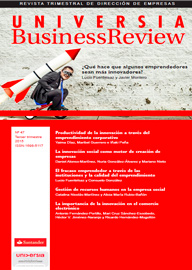
The articles published in number 47 of the Universia Business Review offer a monographic study of "Entrepreneurship as a social and economic phenomenon". The papers published were defended at the 9th international Workshop based on GEM data (July 2015) after a rigorous selection process. The Scientific Secretariat of the Workshop and the UBR Steering Committee selected several lines of research and invited their authors to submit their papers to the established editorial process. The Steering Committee would like to thank Professor Alicia Rubio (University of Murcia) for her work, as well as all the editorial effort in identifying the authors, carrying out the review process and proposing the papers that met the requirements of the UBR.
Entrepreneurs play a crucial role when introducing innovations on the market. However, there are major differences among them, resulting in only a few that effectively introduce the most new products or services. In the first article, Professors Lucio Fuentelsaz and Javier Montero (University of Zaragoza) attempt to characterise individuals who are more likely to take innovative initiatives by using a sample of more than 65,000 entrepreneurs from 88 countries who participated in the GEM project from 2008 to 2012. The results concluded that, in psychological terms, the most important variables are risk tolerance, awareness of opportunities and individuals’ self-confidence. From a human capital standpoint, education and previous experience are especially relevant. As a result, any government policy geared towards improving the level of innovation of an economy will have to stress some of these variables.
According to Yaima Díaz, Maribel Guerrero and Iñaki Peña (Deusto Business School), there are few entrepreneurs in Spain, and of these, fewer still are clearly committed to innovating. Launching innovation-oriented business projects can lead to business failure. In the following article they analyse the effect of corporate entrepreneurship on the productivity of innovation obtained by recently created spin-offs. The results reveal that new spin-offs that have the support of a parent company, and that can absorb information more easily and have a clear entrepreneurial market focus, better capitalise on the efforts made in innovation by launching unique products and services. Both conditions – the capacity to absorb and entrepreneurial focus – are essential for making the most of the effort put into innovating, and where possible, these two conditions should be developed under the guidance of a parent company (corporate entrepreneurship) as this increases their chances of success.
In the next article, Professors Daniel Alonso Martínez, Nuria González Álvarez and Mariano Nieto (University of León) highlight the need to create socially innovative environments in order to boost business creation in a region. The authors determine that these more socially innovative environments reap some of the benefits generated by public innovation policies when creating new businesses. Furthermore, they conclude that the influence of public policies on business creation, in this case measures such as public investment in R&D, is likewise a fact. This points to the importance of adapting public policies to the growing needs of society, and to the economic, technological and social development of a territory. At the same time, the fact that innovations enable opening new business opportunities, developing new products and services and accessing new markets is also a fact.
Business failure is at least as significant as business success. However, academics and professionals have spent much more time analysing the latter. Research by Professors Lucio Fuentelsaz and Consuelo González (University of Zaragoza) focuses on failure, suggesting that in order to understand it you have to consider the institutional context and the quality of entrepreneurship. In a sample of 69 countries between 2007 and 2012, the authors show their failure rates depending on the institutional framework and the quality of business enterprise. The results reveal that there is less business failure when the institutions are well-developed and when the quality of business enterprise is higher. And, interestingly enough, the business failure rate is lower when both dimensions, institutions and quality, move in the same direction.
More and more social enterprises are making up the productive fabric of the country. As with any organisation, they must be managed efficiently. However, there is little research that analyses the management of these kinds of companies, and even less that focuses on human resource management. Professors Catalina Nicolás Martínez and Alicia Rubio Bañón (University of Murcia) used case studies to analyse the human resource management by Spanish social enterprises. The results confirm that social enterprises organise internships that sometimes differ from those organised in non-social enterprises due to the strong social component that moves them and which attracts workers to contribute to their mission. To prevent social enterprises from losing talent, they need to organise internships that are ethical and responsible in terms of human resources, and manage the volunteers that collaborate with them in accordance with their characteristics.
In the last article, Professors Antonio Fernández Portillo, Mari Cruz Sánchez Escobedo, Ricardo Hernández Mogollón and Héctor Valentín Jiménez Naranjo (University of Extremadura) propose an economic approximation of electronic commerce on a world, European, national and regional level (Extremadura), underscoring the high potential of e-commerce growth in national and regional companies. The authors suggest a model with predictive capabilities that associates company age, size and innovation with e-commerce, showing the relationship between innovation and e-commerce, company size and e-commerce, and where the age of a company also has a positive influence on innovation and size, with innovation being the key to developing e-commerce and benefiting from it.
I encourage you to read all the articles and would also like to thank everyone for their trust: Associate Editors, members of the Scientific Committee, Editorial Board, evaluators, collaborating authors, companies and especially our readers, both from the university and business communities.Published: 2015-09-10