.png)
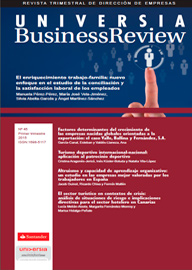
Universia Business Review (UBR) enters its twelfth year faithfully maintaining its regularity and guaranteeing its internationally-recognised principles of editorial excellence. We would like to reaffirm the Management Board's commitment to focusing on those principles in order to remain listed in the main international databases and for the UBR to continue to be regarded as an outstanding scientific journal. For this reason, we are currently being re-evaluated by the Social Science Citation Index and are optimistic about the possibility that the Review will again be accepted within a reasonable timeframe.
This focus on quality has allowed UBR to hold the journal certification of "EXCELLENT" from the Spanish Ministry of Science and Innovation's Foundation for Science and Technology (FECYT). It is also listed in SCOPUS (Elsevier Bibliographic Databases. Scimago Journal Rank 2013 (SJR): 0,184 Q3; Category: Business, Management and Accounting) in position 151 of 267, and currently occupies second place among 71 Spanish journals in the field of economics (Index H for Spanish Scientific Reviews, according to Google Scholar Metrics, 2009-2013). We encourage authors to submit articles that, in meeting the necessary requirements, allow managers and entrepreneurs to find solutions to their thinking, problems and concerns.
As in the first editions of every year, we would like to express our very sincere appreciation for the work of the Associate Editors and professors. Through their efforts as evaluators over the last year, they have provided the best formal guarantee of the rigour of the Review's articles, suggesting improvements and ensuring that the level of quality is maintained. In 2014, we received 201 articles, with a 9.3% acceptance rate for those evaluated.
In the first article, Professors Manuela Pérez-Pérez, María José Vela-Jiménez,
Silvia Abella-Garcés and Ángel Martínez-Sánchez (University of Zaragoza) examine the enhancement of work-life balance as an explanatory link in the effect that flexible human resources practices have on job satisfaction and the organisational commitment of employees. For the authors, the results of a study carried out at family-responsible companies in Spain indicate that the explanatory power of enhancement in a positive sense is greater than that of conflict in a negative sense.
Valle, Ballina y Fernández, S.A., the producer of the well-known El Gaitero brand of cider, is a century-old company that fits the profile of a business created with a global objective, oriented towards regional exports. That is because it was created to take advantage of the overseas opportunities in the cider trade associated with Asturian emigration to Latin America. On the basis of this company's historical development, Professors Esteban García-Canal and Ana Valdés Llanez (University of Oviedo) examine determining factors in the initial growth, and possible subsequent corporate development, of export-oriented companies created with a global objective.
For Professors Cristina Aragonés-Jericó (Florida Universitaria), and Inés Küster-Boluda and Natalia Vila-López (University of Valencia) the aim of the next article is to compare the tourists and residents in country hosting a major sporting event with tourists of other nationalities. In order to do this, the authors work from a global sports-sponsorship model based on models of tourist behaviour and sports sponsorship theories. The results allow us to conclude that there are significant differences in some variables of the proposed sponsorship model between domestic and foreign tourists, including experience of the event, the motivation of sports tourists, and identification with the team or competitor.
The new characteristics of the economic and business environment have led to organisational learning capacity becoming a key factor in a company maintaining its competitiveness and achieving success. The need therefore arises to develop business strategies that allow organisations to be created with a high learning capacity. Professors Jacob Guinot, Ricardo Chiva and Fermín Mallén (Jaime I University) demonstrate the importance of altruism in organisations when it comes to facilitating the organisational learning process, thereby leading to an improvement in organisational performance.
The complex nature of the tourism sector and its international dimension contribute to it being one of the industries most exposed to various critical situations. As tourism is an activity that has a relevant impact on the development of the economy, identifying the kinds of crisis that may affect this sector has emerged as a key concern in hospitality management. In this final article, the analysis of the information provided by a panel of experts reveals not only that there are economic crises, but that the tourism sector is faced with numerous types of risks and adverse situations. On the basis of the results obtained, Professors Luis Melián Alzola, Margarita Fernánde Monroy and Marisa Hidalgo Peñate (University of Las Palmas, Gran Canaria) propose a management agenda that contributes to controlling and even minimising the negative impact of potential and real situations of risk.
I encourage you to read all of the articles. We hope, during the coming year, to continue counting on everyone’s support: the Associate Editors, members of the Scientific Committee, Editorial Board, evaluators, contributing authors, companies and, above all, the readers − from both the academic and business worlds.Published: 2015-03-09