.png)
Segundo trimestre
No. 42 (2014)
Letter from Editor in Chief
The strong competitive pressure felt by the automotive sector is leading it to seek solutions that will radically improve its efficiency. Along this line, professors Jesús F. Lampón and Paul Cabanelas (University of Vigo) explore the implications of implementing modular platforms in the sector´s production organization. The analysis of the three major European automakers, Volkswagen, PSA Peugeot-Citroen and Renault-Nissan, shows that the use of this modular architecture will ensure greater flexibility in their production network, greater economies of scale and intensification of internal rivalry between its plants in the allocation of production quotas. Finally, this new organization promotes the elimination of part of the installed overcapacity and implies new challenges for managers of manufacturing plants in the face of possible rationalization of production capacity in Europe.
In the following article, Mª Teresa Corzo Santamaría (Universidad Pontificia de Comillas), Jorge Martin Hidalgo (UBS) and Margarita Prat Rodrigo (BME) analyse the risk characteristics and profitability of the Global Macro hedge funds strategy and its incorporation into portfolios of stocks and bonds. The results show that it is a competitive strategy in terms of risk and return, which provides Sharpe ratios higher than that of the major world and Spanish variable rates. Likewise, the appropriateness of including Global Macro hedge funds in portfolios is shown. The ideal proportion is between 15% and 20%. The appropriateness is shown of including this strategy in the currency itself (Euros in this case) in which the portfolio it will be inserted in is denominated.
Over the past two decades, the number of ISO 9001 certified companies has been growing steadily and by the end of 2011 it had grown to more than 1.1 million worldwide (ISO, 2012). However, the distribution of certificates among countries does not match the weight that each one has in the global economy. On this subject, according to Olga Rodriguez-Arnaldo and Angel R. Martinez- Lorente (Universidad Politécnica de Cartagena), it may be that companies obtain an ISO 9001 certificate by deceiving or bribing auditors. Findings indicate that the level of corruption is low but has a statistically significant influence on national implementation of ISO 9001, a ratio that becomes stronger if we analyse only developed countries. If confirmed, this would be a major criticism of the functioning of the ISO 9001 system and could result in a loss of confidence in the standards by companies themselves.
Product range is one of the most important tools available to the retailer to differentiate themselves from their competitors, attract consumers to the establishment and raise their sales. Juan Carlos Gázquez-Abad (University of Almeria), Francisco J. Martínez-López (University of Granada), Irene Esteban-Millat (UOC) and Juan Antonio Mondejar-Jimenez (University of Castilla-La Mancha) analyse whether indeed, there is a direct relationship between product range - in terms of number of references - and the level of sales in the category. The authors have panel data on the weekly evolution of product range and the level of sales of twelve product categories between 2008 and 2012 in a set of hypermarkets and supermarkets operating in Spain. The results confirm that the relationship between the two variables is positive and significant in all cases, although its intensity depends on the frequency of purchase and the level of penetration of the particular product category.
Professors Ismael Barros Contreras (Universidad Austral de Chile), Juan Hernangómez Barahona and Natalia Martín Cruz from the University of Valladolid, apply the theory of dynamic capabilities to the study of family businesses and introduce the concept of ´dynamic familiarity´ to demonstrate the ability of a family business to create on purpose, extend or change its unique set of resources stemming from the interaction between the family, its individual members and the business. The authors want to provide evidence on how the generation and reconfiguration of resources in the family business occurs, which allows its evolutionary adaptation and survival over generations. To achieve this objective, they apply a case study to the Yllera Group, a representative company of the group of family firms in Spain.
A new business model known as e-markets has emerged in recent years. The last article helps to discover what they are and how they work. The authors, M. Soledad Janita and F. Javier Miranda of the University of Extremadura, propose strategies aimed at ensuring the loyalty of vendors-users toward e-markets. One gathers from the results obtained in the study of the construction industry the importance to achieve this purpose that appropriate management of the quality of the website has, the care of the corporate image of the e-market, as well as that users perceive that the e-market provides them with value.
I wouldn´t want to conclude without acknowledging the work done during this last period by the Area Editors, the members of the Scientific Committee, the Editorial Board and reviewers.
Primer trimestre
No. 41 (2014)
Letter from Editor in Chief
Universia Business Review begins its eleventh consecutive year, faithfully consistent and ensuring the internationally renowned principles of quality publishing. Despite the evolution and recognition as a quality science journal, Thomson-Reuters informed that UBR will no longer be indexed at the Journal Citation Reports-Social Science Citation Index, although it is still indexed in other reference databases.
Undoubtedly, this is the time to suggest changes in the direction of the journal and return to our funding mission and objective: “transmit to those who are responsible for managing companies and businesses the most innovative ideas and developments that scientific and academic fields are capable of generating”. We should answer the following questions when writing, proposing and selecting the pieces of work to be published in the journal: What is the main message or idea of the article? Can it be applied by entrepreneurs and executives? Why do you think that entrepreneurs should read your article? Which companies would find it useful and which would not? What research has been carried out to increase your proposal? On which work (articles, theories, etc.) is your proposal based on? Executives and entrepreneurs must find answers to their reflections, concerns and problems in the scholars’ work. The Management Committee, together with the Area editors, will work along these lines to face the changes needed in this new phase.
We sincerely appreciate the efforts of the associate editors and professors who, over the last year, through their work as evaluators, have been the best formal guarantee of consistency of the journal’s pieces of work, suggesting improvements and ensuring the compliance of quality standards, although on occasions it has not been totally successful. During 2013, 252 articles have been received and the rate of acceptance of the articles evaluated was 9.95%
Cuarto trimestre
No. 40 (2013)
Letter from Editor in Chief
This special issue of Universia Business Review is devoted to the role played by knowledge and innovation in strategic management. ‘Knowledge, Strategy, and Innovation in the firm’ is a special issue in which leading knowledge and innovation management scholars have participated. Some of them are members of the Scientific Cometee of the Nonaka Centre for Knowledge and Innovation of CUNEF Business School in Madrid. This Centre, which was inaugurated in November 2011 by its Honorary President Professor Ikujiro Nonaka, focuses its activities on Knowledge Management, Innovation and Firm Strategy research and training.
This special issue has been possible thanks to the honorary collaboration Professor Ikujiro Nonaka and the work Professors María Ángeles Montoro-Sánchez and Gregorio Martín-de-Castro, both of Complutense University of Madrid, and members of the Executive Board of the Nonaka Centre for Knowledge and Innovation. The Scientific and Executive Boards of Universia Business Review would like to acknowledge the fantastic work done in editing the special issue, contacting the authors and managing the review process and accepting papers that fit the academic requirements of the journal.
The seven articles that comprise this special issue provide theoretical reviews and case studies on the main issues in the debate on the firm’s existence and development: knowledge, innovation, and strategy. These papers address the basis of firm strategy, the important role of innovation and its related sources, as well as the need to further theoretical foundations with new visions, where knowledge is an important element of the firm´s existence and survival. Looking at the content of the special issue, practitioners, entrepreneurs, and managers will have the opportunity to see and verify the value of academic research.
In the first article Professors David Teece of University of California at Berkeley in the US and Abdulrahman Y. Al-Aali of King Saud University in Saudi Arabia, provide a theoretical analysis on the multinational enterprise. Taking the eclectic paradigm as the starting point, the authors explain how the concepts of dynamic capabilities, knowledge management, and entrepreneurship provide a better understanding of the multinational enterprise. The paper concludes with a set of managerial implications for multinational enterprises.
Professors Paul Adler of University of Southern California in the US and Charles Heckscher of Rugters University in the US, propose in the next article a new type of organizational form called collaborative community that enables a firm in a complex and dynamic environment achieve high levels of performance in both exploration and exploitation, achieving ambidexterity performance. The new type of organization –the collaborative model- combines mechanistic and organic organizational forms, requiring a new type of trust –collaborative trust- jointly with a specific set of values, norms and authority system. The authors conclude the paper with the case of the U.S. health company Kaiser Permanente.
Taking the issues introduced in 1937 by Ronald Coase on the existence, limits and coordination mechanisms of firms as the starting point, Professor J. C. Spender of ESADE in Spain, returns to the ongoing debate of these issues among management and economic researchers. He not only provides a criticism but also raises new questions, and highlights the role of context, imagination, and judgment to delimitate and respond to these issues.
The article of Professor Hirotaka Takeuchi of Harvard University in the US, provides a review of current thinking on the Knowledge-Based View of the Firm. Firms differ from each other, not just in business activities, resources and competences, but also in the different visions on the future of the people who decide and implement strategy. It is necessary to take into account all these issues in order to analyze the strategy pursued. This paper explains how the knowledge-based view complements the contributions of the classical schools of thought on strategy and, especially, on aspects related to the role of people as the core of the strategy, the consideration of strategy as a dynamic process, and the firm´s social agenda.
In the next article, Professor Stephen Tallman of University of Richmond in the US, studies alliances and location in clusters as new forms of access to external knowledge. Given that firms are increasingly dispersing their value-added operations around the globe and outsourcing them to alliances, external knowledge sources are becoming increasingly important. This paper reviews the main research topics related to alliance networks, as well as their location in clusters as external sources to access to new knowledge.
Professor Robert M. Grant of Bocconi University in Italy, provides empirical evidence on knowledge management via a multiple case study in the international oil industry. He shows two main ways of understanding and implementing knowledge management in business activities. The paper illustrates on the one hand the application of information and communication technologies in the management of explicit knowledge and, on the other hand, the use of knowledge management techniques to facilitate face-to-face explicit knowledge transfer.
Professors Gregorio Martín-de Castro and María Ángeles Montoro-Sánchez, both of Complutense University of Madrid and Nonaka Centre for Knowledge and Innovation of CUNEF Business School in Spain, propose, review the main theoretical issues on leadership and organizational context. Terms such as distributed or wise leadership, ba, social capital or collaborative context are analyzed and integrated. Finally, this paper proposes a new research framework, called configurational, which emphasizes the study of complex phenomena in social sciences, where causality is rarely presented in isolation, and where the co-joint analysis of causal conditions offer greater explanatory power.
With this special issue we hope that entrepreneurs, managers and scholars find useful the contributions made in each of their areas. This will help the practitioner and academic communities share knowledge on business management, which is key for the development of our society.
I would like to acknowledge the editorial work of Professors María Ángeles Montoro-Sánchez and Gregorio Martín-de Castro, the contributions by the authors of this issue, all worldwide recognized professors and researchers in the field of knowledge, innovation and strategy in the firm, as well as the work of reviewers, who with their generous collaboration have made possible this special issue fulfills the standards required by UBR. I encourage you to read this special issue.
Tercer trimestre
No. 39 (2013)
Letter from Editor in Chief
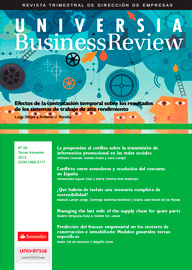
It is widely held that the use of temporary work offers a number of relevant advantages to companies, especially in the turbulent economic context of our time. In the first article of this issue, Antonio Revilla and Luigi Stirpe, of Carlos III University (Universidad Carlos III), bring to our attention an undesired effect of temporary recruitment, as they analyse its interaction with human resources policies aimed at permanent employees. Specifically, they focus on the so-called High Performance Work Systems (HPWS) and find out that the working of these systems is adversely affected as the proportion of the company’s temporary employees increases. These results show that some initiatives may appear profitable when looked at individually, yet when combined among themselves can be less profitable, thus inviting professionals not to ignore the systemic nature of human resources policies in the elaboration of their workforce segmentation strategies.
Gossip is a universal activity, yet for Shintaro Okazaki, Natalia Rubio and Sara Campo, of the Autonomous University of Madrid (Universidad Autónoma de Madrid), it has not been sufficiently dealt with from the area of marketing nor in the context of the social networking sites (SNS). To this end they analyse how the tendency to gossip contributes to promote brands on the SNS. They carry out a survey among SNS users where they suggest a scenario of promotion of products of varying degree of implication – namely beer, sport shoes and laptops. The results of the work confirm that the tendency to gossip favours the dissemination of promotional information. Independently from the type of product, tendency to gossip helps strengthen links within the SNS and favours electronic word-of-mouth (e-Wom) on SNS. In addition, after a certain degree of implication, a significant direct effect is observed between the tendency to gossip and e-Wom on the SNS.
Lecturers Inmaculada Aguiar Díaz and María Victoria Ruiz Mallorquí, of the University of Las Palmas de Gran Canaria, Spanish Canary Islands (Universidad de Las Palmas de Gran Canaria), analyse the incidence of the type of creditors in the solution of the arrangement, and particularly of the conflict between bank and commercial creditors. For the authors, the results obtained by a number of non-listed Spanish companies lead to the following conclusions: i) that the different priority given to them by law concerning the recovery of their claims involves different preferences by creditors on the solution of the arrangement, and ii) that the existence of conflict between both types of creditors reduces the probability of re-organisation of the companies now bankrupt.
In the face of the diversity of pronouncements issued these last years to satisfy the need for information on the socially-responsible conduct of organisations, Domingo Martínez Martínez, Manuel Larrán Jorge, and María José Muriel de los Reyes, of the University of Cadis (Universidad de Cádiz), seek to develop a wide framework to help those interested in Corporate Social Responsibility (CSR) to identify the different actions and strategies related to sustainability in each of its dimensions. The analyses conducted, both of the framework and of the 15 initiatives selected for its elaboration, show that the standard used as a reference in the elaboration of the reports conditions significantly their content, and that the practical work of the social dimension and those related to the employee stakeholder receive the greatest attention.
In the following article Beatriz Minguela-Rata, of the Complutense University of Madrid (Universidad Complutense de Madrid) and Sander of Leeuw, of the VU University Amsterdam and Nottingham Business School, analyse the design of the last-mile supply chain of spare parts used by consumers in repair activities carried out by themselves. A survey was distributed among Dutch consumers to help identify the preferred delivery methods, and the characteristics of the orders. The results indicate that there is a general desire among consumers to carry out repair activities themselves, and that they prefer direct delivery of the spare parts. As for the characteristics of the orders, it depends on the prevailing characteristics, such as age or the critical nature of the actual spare parts.
We close the issue with an article by Belén Gill de Albornoz, of the Jaume I University (Universitat Jaume I) and Begoña Giner, of Valencia University (Universitat de Valencia). The authors seek to find out whether the estimate of specific sector models enables a better forecast of failure than the estimate of a general model. The results confirm that profitability, stock rotation, debt, liquidity, growth, age, and general economic conditions affect the probability of insolvency, but there exist differences between sectors. On the other hand, even if to a building company a specific sector model has similar forecasting capacity than a general model, this is not the same for the real estate sector.
On a final note, I would like to thank the Area Editors, the members of the Scientific Committee, the Editorial Board and the reviewers for the task they have carried out during this last period.
Segundo trimestre
No. 38 (2013)
Letter from Editor in Chief
In May 2013 Universia Business Review renewed its editorial quality seal for Spanish scientific journals, awarded by the Fundación Española para la Ciencia y la Tecnología (Spanish Foundation for Science and Technology - FECYT), which classed the publication as "OUTSTANDING”. This quality seal was first awarded in May 2011 for a period of 2 years, to 79 journals that passed the 1st and 2nd round of tests applied to hundreds of scientific journals submitted from all the different branches (pure sciences, social sciences, life sciences and humanities). Of those 79, only 52 seals have been renewed. This distinction endorses the scientific quality of the articles published in the accomplishment of our mission: to convey to those responsible for managing companies and businesses the most innovative ideas and developments generated within the realms of science and academia.
For that reason, we would like to remind authors and reviewers that the Universia Business Review is continuing to serve the university and scientific community as a leading publication, through which specialists can systematically follow the latest contributions made by peers in their same field. It is important to remember that articles must be written in such a way as to be easily read and understood by a non-academic audience. Overly specialist language should be avoided to foster an easier understanding of the ideas put forward and, as far as possible, the excessive use of highly academic terms and mathematical functions should be avoided, even if they might have been used for the reviewers to analyse the scope of the research submitted. Conclusions should not simply provide a summary of the article, but rather should offer a lesson or application that can be transferred to the heads of companies so they can take it as "good advice" and, more importantly, so that they can understand and develop it.
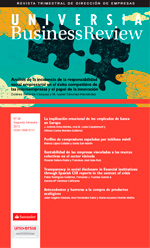
In the first article, Dolores Gallardo Vázquez and M. Isabel Sánchez Hernández, from Extremadura University, analyse the impact of Corporate Social Responsibility (CSR) on the competitive success of micro-businesses. The analysis incorporates innovation as a mediating variable in the relationship, and the business sector as the control variable, ruling out its moderating effect. According to these authors, the main contribution of this research is to demonstrate the link between CSR actions and the competitiveness of micro-businesses in an empirical and reliable way. In these times of crisis, when the responsibility of large companies is being severely called into question, micro-businesses should include CSR among their strategies to become more competitive. The findings of this study show, according to the authors, that CSR is not specific to large companies with major resources; nor is it incompatible with innovation and business competitiveness; quite the opposite.
According to José Antonio Ariza, Ana Lucia Casademunt and Alfonso Carlos Morales Gutiérrez from ETEA (Cordoba University), the transformations that have taken place in the financial system require a renewal of human resources practices to achieve sustainable results through the development of people. This article endeavours to identify the profile of banking employees who are engaged emotionally with their working activity. The results obtained by applying a logistical regression model reveal the main variables where action should be taken by the heads of human resources in financial entities if they wish to increase the level of emotional engagement among their employees: invest in training, improve relationships, manage teams and monitor stress levels.
The mobile phone is a marketing instrument that offers great potential for companies owing to its high level of penetration in the market and its characteristics of interactivity, personalisation, ubiquity, localisation and convenience. Blanca López Catalán, from Pablo de Olavide University, and Sonia San Martín, from Burgos University, set out to ascertain the profile of mobile shoppers with regard to confidence, compatibility between lifestyle and mobile purchasing, entertainment, personalisation, security and peer influence. They also characterise groups using sociodemographic variables. Companies looking to engage in mobile commerce must segment their target audience and adapt their strategies to each group according to its characteristics. On the basis of the profiles obtained, according to the authors, receptive individuals make up the primary target for vendors.
Ricardo Sellers Rubio and Francisco José Más Ruiz, from Alicante University, aim to analyse the profitability of companies incorporated into a collective brand in the Spanish wine industry. The basic supposition is that the collective brand can explain the profitability of the wineries, because collective reputation is a mark of quality that diminishes the consumer's perception of risk. For these authors, the results obtained show that only some collective brands have a positive effect on the profitability of wineries in comparison to those that are not covered by collective brands. Furthermore, profitability is positively associated with the diversification of the winery into two or more collective brands.
In the following article, Pablo Rodríguez Gutiérrez and Fernando José Fuentes García, from Cordoba University, analyse the phenomenon of Corporate Social Responsibility (CSR) in the Spanish banking sector through social responsibility reports. Using "Legitimacy" and "Stakeholder" theory, the use of CSR is justified to analyse informative behaviour in relation to surroundings. The methodology used was content analysis; in particular, they analyse and compare informative practices in relation to four pillars around which CSR is organised: Customers, Community, Employees and Environment. Specifically, they propose a responsibility content index (RCI) that measures the quality and level of detail of the information provided. The study concludes that the information supplied is heterogeneous, and most information is provided particularly in the categories of Community and Environment, in general, although social entities (Savings Banks and Credit Cooperatives) are the most transparent when it comes to Customers and Community.
The main aim of the next article is to understand the mechanism that explains environmentally friendly buying practices, with a view to offering practical and useful information to companies. Hence, Julen Izagirre Olaizola, Ana Fernández Sainz and María Azucena Vicente Molina, from the País Vasco University, analyse the factors that determine favourable environmental behaviour and the extent to which different types of environmental behaviour affect the specific behaviour of buying environmentally friendly products, bearing in mind the possible barriers to such purchases. The authors' main conclusion is that if the aim is to popularise the consumption of environmentally friendly products, companies will have to meet the needs of a majority of environmentally aware consumers who have not yet been mobilised towards eco buying.
Before I sign off, I would like to thank the Area Editors, members of the Scientific Committee, the Editorial Board and reviewers for all their hard work over this past period; without them, UBR would not have attained its current recognition.
Primer trimestre
No. 37 (2013)
Cuarto trimestre
No. 36 (2012)
Tercer trimestre
No. 35 (2012)
Segundo trimestre
No. 34 (2012)
Primer trimestre
No. 33 (2012)
Cuarto trimestre
No. 32 (2011)