.png)
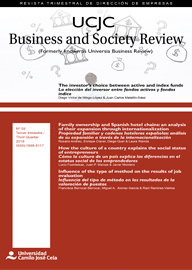
In the first article, professors Diego Víctor de Mingo-López and Juan Carlos Matallín-Sáez (Universidad Jaume I) compare the performance of actively-managed mutual funds and index funds. For a large sample of US domestic equity share-class funds, we analyze the relation between portfolio turnover and fund risk-adjusted return. Using gross returns, results indicate that before (after) the onset of the recent financial crisis, low-turnover active funds reach higher (similar) results than those obtained by index funds, whilst high-turnover active funds have similar (worse) returns to index funds. For the authors the same evidence is found when net returns are considered, but index funds perform comparatively better due to their lower costs. From an investors’ perspective, investing in previous high-turnover funds could lead to lower overall risk-adjusted returns.
The relationship between family-firm status and internationalization strategy has been widely discussed in the family business literature. However, for the professors Rosario Andreu, Enrique Claver, Diego Quer and Laura Rienda (Universidad de Alicante), prior studies did not address this topic in the case of the Spanish hotel industry, even though this being a highly internationalized sector with a high proportion of family firms. For this reason, the aim of the study is to examine whether the family character of Spanish hotel chains has conditioned their internationalization strategies. For the authors, the results show that positive aspects possibly prevail in Spanish family hotel chains which encourage these enterprises to commit themselves more strongly to internationalization and to adopt riskier growth strategies
Despite the benefits of entrepreneurial activity on economic development, entrepreneurs do not have a good social status in all societies. While in some countries they are highly respected (Anglo-Saxon context), in others, their image is not so positive (European context). In this paper, professors Lucio Fuentelsaz, Juan P. Maícas (Universidad de Zaragoza) and Javier Montero (Universidad de Deusto) highlight these differences using a sample from the GEM project and explain the social status of entrepreneurs using the cultural profile of countries, which is measured with the Schwartz database. Theirs results show that some cultural profiles favor entrepreneurs’ social status.
Today, many organisations believe that it is essential to evaluate jobs. If this is so, what is the most appropriate method for my organization? Is one that has been designed ad hoc better or a commercial one? To answer these questions, professors Francisca Berrocal Berrocal, Miguel Aurelio Alonso García, and Raúl Gonzalo Ramírez Vielma (Universidad Complutense de Madrid) examine whether differences exist when classifying and ordering jobs according to the evaluation method used, in order to provide recommendations that will make it easier for human resources departments to make decisions and ensure success in the application of the results.
I encourage you to read all the articles. We hope to continue to have everyone's trust: Associate Editors, members of the Scientific Committee, Editorial Board, evaluators, author-collaborators, companies and above all the readers from both the University and the business world.
Published: 2018-09-27