.png)
Universia Business Review begins its fifteenth year faithfully fulfilling its publication intervals and confirming its internationally recognised principles of editorial quality. We would like to emphasise the Editorial Committee’s commitment to continuing to be indexed in the main international databases (Web of Science and SCOPUS) and ensuring that UBR reinforces its reputation as a scientific journal of proven quality.
As always in the first issue of the year we would like to express our sincere thanks to the associate editors and academics for their excellent work as assessors. They are the finest formal guarantee of the soundness of the articles we publish and ensure that our demanding standards are maintained. In 2017 we received 100 articles, of which 16.1% of those submitted for evaluation were published.
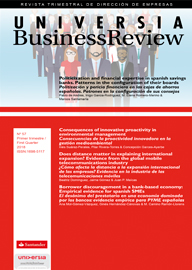
In the first article Pablo de Andrés, Iñigo García-Rodríguez (Universidad Autónoma de Madrid), María Elena Romero-Merino and Marcos Santamaría (Universidad de Burgos) present an in-depth study of the politicisation and financial knowledge-experience of the boards of directors of Spanish savings banks. To do so, they have built up a database of biographical information on the directors involved for the period 2004-2010. The results of the cluster analysis reveal that the boards can be divided into four groups based on the degree of politicisation and financial expertise of their members. They reach the conclusion that the banks with the highest levels of financial expertise on their boards also achieve the highest levels of financial solvency.
An innovative attitude as the driving force behind the environmental strategy has been well proven in the literature on environmental management. In the following article Inés Suárez-Perales, Pilar Rivera-Torres and Concepción Garcés-Ayerbe (Universidad de Zaragoza) analyse this relationship by studying how the development of an advanced or proactive innovative attitude, characterised by implementation of innovation practices beyond the usual practice in the sector, affects the environmental strategy. The authors note that companies with a proactive innovative strategy are far more capable of achieving proactive positions in the implementation of their environmental strategy. This leads them to conclude that proper development of the innovative capacity enables them to harness resources and accumulate experience and knowledge that help them to take up proactive positions in their environmental strategy.
The goal of the next article is to study the effect of distance between countries on selection of the country of destination. In particular, Beatriz Domínguez (Universidad CEU San Pablo), Jaime Gómez (Universidad de La Rioja) and Juan P. Maícas (Universidad de Zaragoza) make use of two dimensions of the distance between the country of origin and that of destination to explain entry into foreign markets: (1) the geographical dimension and (2) the existence of historical ties. Taking the mobile telecommunications industry as a reference, the authors provide a three-stage approach composed of an in-depth descriptive study, an empirical analysis and presentation of three paradigmatic cases in the sector. They conclude that companies are more likely to enter countries at smaller geographical or historical distances from their own and that historical ties positively moderate the relationship between geographical distance and entry.
In the last article Ana Mol-Gómez-Vázquez (Universidad de Almería), Ginés Hernández-Cánovas and M. Camino Ramón-Llorens (Universidad Politécnica de Cartagena) analyse the explanatory factors behind discouragement of borrowers in a sample of SMEs that operate in an economy dominated by banks. The results show that pronounced informational asymmetries and loan application costs increase the probability that the borrower, especially smaller companies and those that work with fewer banks, will be discouraged from applying for loans. The authors also conclude that companies whose managers have a proactive attitude to growth and business improvement are less likely to be discouraged from such requests.
I encourage you all to read all the articles. We hope to continue being worthy of your trust during the coming year. Associate Editors, members of the Scientific Committee, Editorial Board, assessors, author-collaborators, companies and especially the readers, both from the universities and from the business world.Published: 2018-02-25