.png)
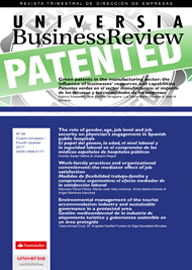
In the first article, Sabina Scarpellini, Pilar Portillo-Tarragona (UniversityofZaragoza), Luz María Marín-Vinuesa (UniversityofLa Rioja) and José M. Moneva (UniversityofZaragoza) aim to provide professionals with an analysis of manufacturing sector companies with green patents, associating their financial-economic characteristics with their number of national and European green patents. They especially analyzed the relation between collaboration with R&D centers and holding patents. The results, obtained through an ad hoc database of 1,606 Spanish companies, indicate that the collaborative capacity for R&D provides a useful explanation for Spanish manufacturing companies holding green patents. In addition, the companies’ financial performance, maturity and size are considered relevant for the development of green patents.
For professors Andrés Salas-Vallina and Joaquín Alegre (UniversityofValencia) the goal of their article is to analyze how the variables of age, gender, job status and job security affect employees’ job commitment, and our goal is to provide new evidence. A sample of 167 doctors specializing in allergology was analyzed. The results help clarify the contradictions found in prior research, as they show that age does not affect job commitment; while gender, job status and job security are variables that do.
In the following article, Manuela Pérez-Pérez, María-José Vela-Jiménez, Silvia Abella-Garcés and Angel Martínez-Sánchez (UniversityofZaragoza) analyze whether job satisfaction has a mediating effect among the availability of work-family reconciliation measures and employees’ organizational commitment. The study data was obtained from a sample of 322 employees from Spanish companies which were recently given the “Flexible Company Award” or are certified as a “Family Friendly Company”. The authors conclude that employees are more satisfied with their job when they perceive that they can truly rely on work-family measures to balance their professional and family lives, and this satisfaction also has a positive impact on their organizational commitment.
In the final article, Yaiza Armas-Cruz, M. Ángeles Sanfiel-Fumero and Olga González-Morales (UniversityofLa Laguna), analyze the environmental management of the hotel industry and its relation with governance of a mass destination constrained by its consideration as a protected area (Biosphere Reserve). For a sample of 94 establishments in Fuerteventura (Spain) the authors determine the level reached by their environmental protection and their driving and obstructing factors. They conclude by identifying the differences between hotel and extra-hotel infrastructure, contributing to the definition of a sustainable tourism governance model based on public-private coordination.
I encourage you to read all the articles. This year we hope to continue to earn the trust of everybody: Associate Editors, members of the Scientific Board, Editorial Board, evaluators, authors-collaborators, businesses and above all readers, both from the University and the world of business.
Published: 2017-12-10