.png)
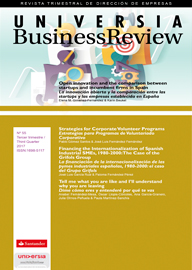
In the first article, Professors Elena M. Gimenez-Fernandez (Complutense University of Madrid) and Karin Beukel (UniversityofCopenhagen) compare the open innovation strategy between start-ups and established companies over a ten-year period (2004-2013) in a sample of Spanish companies. The authors find that innovation strategies differ considerably, a fact which has implications for business administration. Established companies and start-ups differ in terms of their use of external cooperation activities as a source of innovation. Because start-ups lack financial and human resources, they open their borders to a greater extent than established companies; furthermore, start-ups benefit from being flexible because they have not yet implemented routines. The authors believe that this enhances the result of the start-ups' innovation.
Companies’ lack of awareness of the most effective policies and strategies could be behind their low rates of participation in their Corporate Volunteering programmes. Pablo Gómez Santos and José Luis Fernández Fernández (Universidad Pontificia de Comillas) have attempted to analyse what strategies can be used to effectively implement Corporate Volunteering programmes, based on employees’ motivations for taking part in these kinds of programmes. The authors conducted a qualitative empirical study inSpainto define a model which includes these policies and strategic guidelines, based on the motivations and determining factors for employee participation in Corporate Volunteering programmes.
Professors José Luis García Ruiz (Complutense University of Madrid) and Paloma Fernández Pérez (University of Barcelona) believe that not enough research has been carried out on the role played by funding in the expansion of industrial companies, particularly in small and medium-sized companies (SMEs), which, since the 1980s, have had to cope with the challenges of internationalisation required in the Second Wave of Globalisation. This article is an approach to the problem throughSpain’s case over the 1980-2000 time frame. It offers new information taken from databases and an important case study: it explores the key financial reasons why Grifols has been able to turn itself from a mid-sized company into a large global corporation. According to our research, the way the pecking order works means that large companies steer clear of banks and that there is more bank credit for SMEs. The authors believe that the Grifols case proves that SMEs have easier access to credit if they have a strong international partner on their side.
The increase in employees’ organisational commitment as a way of increasing their yield and bringing down absenteeism, as well as employee rotation, have become key practices in companies. Anabel Fernández-Mesa(UniversityofValencia), Óscar Llopis (Rennes School of Business), Ana García Granero, Julia Olmos Peñuela, and Paula Martínez-Sanchis (UniversityofValencia) propose an innovative perspective, examining issues relating to employees’ personalities. Using the Five-Factor Model (FFM) as a starting point, the authors attempt to understand how each one of these facets has an influence on the employees’ degree of commitment with the organisation, exploring to what degree employees’ personality influences their intention to continue in the company. The authors stress that one of the main practical implications of this study is the empirical verification of the importance of the employee's character as a way of understanding the employee’s degree of commitment.
I encourage you to read all the articles. During the year which is beginning, we hope that all of you will continue to deposit your trust in us: Associate Editors, members of the Scientific Committee, Editorial Council, evaluators, author-collaborators, companies and above all readers from the world of Universities and also the corporate worldPublished: 2017-09-14