.png)
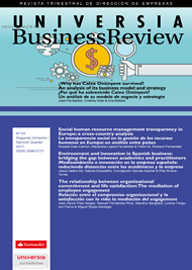
In the first article, professors Jose Pla-Barber, Cristina Villar and Ana Botella (University of Valencia) analyze the keys to the success of Caixa Ontinyent, one of the two savings banks which, remaining true to the founding principles of savings banks, managed to survive the restructuring of the sector as a distinct entity. Using an inductive methodology, the authors draw the dimensions that define both the business model developed by Caixa Ontinyent and its strategy, and reflect how Caixa Ontinyent’s retail banking model and the choices made based on its strategy are completely compatible and aligned with the mission, resources and common values of the entire organization. The authors suggest the need to adjust the business model and strategy to maintain its competitive advantage, link the strategy formulation and implementation, and offer a more dynamic view of the behavior of companies.
Businesses are currently increasingly concerned with showing their social commitment with their stakeholders, including their employees. The second article aims to analyze the responsible management of employees and their transparency. As there are different information requirements in European countries, professors Rosalía Díaz-Carrión, Macarena López-Fernández and Pedro M. Romero-Fernández, of the University of Cádiz, analyze social transparency as determined by national institutional characteristics. Their research focuses on a sample of 195 German, Spanish, Swedish and British listed companies, and the results show quantitative differences in the information regarding socially responsible human resources activities, as well as uniformity in the use of certain reference standards, with the exception of British businesses.
Recent decades have brought an increase in the number of eco-innovative solutions with distinct levels of environmental improvement. Thanks to these solutions, businesses can maintain their competitive position by improving their environmental performance. However, as implementing eco-innovation presents challenges, their number is still limited in Spanish businesses. In this context, professors Jesús Valero-Gil, Sabina Scarpellini, Concepción Garcés-Ayerbe and Pilar Rivera-Torres, of the University of Zaragoza, provide a conceptualization of eco-innovative processes to be adopted by businesses. They also analyze the most relevant barriers and incentives, exploring the specific capabilities and noteworthy changes for practitioners.
In the last article, professors Jean David Polo Vargas (Universidad del Norte, Colombia), Manuel Fernández Rios (Autonomous University of Madrid, UAM), Mariana Bargsted (Universidad Adolfo Ibánez, Chile), Lorena Ferguson Fama, Miguel Rojas Santiago (Universidad del Norte, Colombia) attempt to explore the relationship between Organizational Commitment and Satisfaction with Life, and to determine whether engagement acts as a facilitator. It was proposed that the affective and regulatory dimensions of commitment would create a significant relationship with life satisfaction through engagement. In order to test this approach, data was collected from a sampling of 305 Spanish workers and analyzed using structural equation modeling. It was found that the affective dimension of commitment is the most strongly associated with life satisfaction; this relationship is mediated by engagement, specifically by the vigor or energy experimented at work.
I encourage you to read all the articles. This year we hope to continue to earn the trust of everybody: Associate Editors, members of the Scientific Board, Editorial Board, evaluators, authors-collaborators, businesses and above all readers, both from the University and the world of business.
Published: 2017-06-07