.png)
Universia Business Review begins its fourteenth year by fully adhering to our periodicity and with the standards of editorial quality that are internationally accepted. We want to insist on the commitment made by the Steering Committee to remain indexed in the major international databases and that UBR continues to be viewed as a scientific journal of proven quality. Since January 2016, all UBR articles have been included in the Web of Science, UBR is a part of the Journal Master List and is indexed in the Emerging Sources Citation Index. This commitment to quality has earned UBR the certification of EXCELLENT journal by the Spanish Foundation for Science and Technology, Ministry of Science and Innovation (FECYT) and is indexed in SCOPUS (Elsevier Bibliographic Databases. Scimago Journal Rank 2015 (SJR) : Category: Business, Management and Accounting. Q2, Position 133 out of 285).
UBR is categorized as an A journal and is in position 31 out of 233 (1/11 of the Business journals) of all the Spanish journals of human and social sciences in Web of Science and/or SCOPUS (ISOC-CSIC). UBR currently holds the first position of 87 Spanish journals in the area of “economy and business” according to the H Index of Spanish Scientific Journals according to Google Scholar Metrics, 2011-2015. We encourage authors to submit articles that, complying with eligibility requirements, enable executives and entrepreneurs to find answers to their reflections, concerns and problems.
As in all first issues of each year we would like to sincerely thank the work of the associate editors and professors who, with their work as evaluators in the previous year, have been the best formal guarantee of the rigor of the journal’s submissions, proposing improvements to the articles and guaranteeing the sustained levels of requirement. In 2016 we received 92 submissions, with a 10.96% acceptance rate of the evaluated articles.
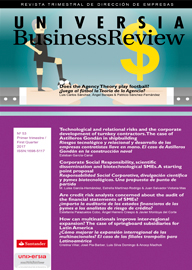
In the first article, Luis Carlos Sánchez, Ángel Barajas and Patricio Sánchez-Fernández (UniversityofVigo) aim to analyze the influence of ownership on the performance of European football teams. Studying efficiency shows their performance in relation to achieving various goals, as is the case with football teams, which strive towards financial performance and sporting success. For the authors, research shows that those football teams organized as clubs with dispersed ownership and not controlled by foreign investors perform better. Thus, ownership structures that facilitate less control over executives positively influence performance.
Turnkey contractors take on a twofold risk during the execution of their projects. On one hand, that of not being able to satisfactorily execute them in terms of cost, quality and/or deadlines. An on the other hand, that the client adopts an unyielding attitude in the renegotiation of the projects by taking advantage of the specific investments made by the business. Using the case of Astilleros Gondán, SA as empirical evidence, professor Esteban García-Canal (UniversityofOviedo) shows the role played by project execution capabilities and accumulated relational capital with clients in reducing the risks mentioned above. The analysis made suggests that the key to managing these businesses is to move into development cycles that enable benefitting from accumulated technical and relational capital instead of constantly executing new kinds of projects for new clients.
One of the reasons most often given by SMEs to avoid implementing Corporate Social Responsibility programs is a lack of resources. The option proposed by professors M. Luisa García-Hernández, Estrella Martínez-Rodrigo (University of Granada) and Juan Salvador Victoria Mas (University of Málaga) is to supply them with something that some have in abundance, knowledge. Dissemination thus becomes the substance of those programs, an accessible resource from which they can obtain benefits, not only in the form of reputation. This study focuses on 32 biotech SMEs located in four Andalusian technological parks. Based on the answers given, the authors believe that it is viable to work with the businesses so that they devote space for information on their websites; improve their relations with local media, until now almost non-existent; and establish ties with their neighbours through direct communication actions, which could be the basis for their CSR.
In the following article, Estefanía Palazuelos Cobo, Ángel Herrero Crespo and Javier Montoya del Corte (UniversityofCantabria) attempt to analyze the usefulness of audits in the loan approval processes to SMEs. Based on a survey of 471 risk analysts in Spain, the authors show that the fact that financial statements are audited increases the perceived quality of the accounting information, decreases the perceived risk in operations, increases the trust placed in the businesses and has a positive impact both on the possibility that the SMEs will be granted a loan and on getting better financing terms.
The last article, by professors Cristina Villar García, José Pla Barber (UniversityofValencia), Luis Silva Domingo (Universidad ORT) and Anoop Madhok (YorkUniversity) analyzes a model of inter-regional expansion using springboard subsidiaries. From their location inSpain, these subsidiaries facilitate expansion of multinational companies inLatin America, inasmuch as they provide part of the necessary experimental knowledge to deal with the region without the initial need to invest there. By analyzing the expansion strategy in the region of five European multinational businesses, the authors propose an inductive model, where the functions of the parent company –coordination, control and knowledge generation – are distributed between the parent company and the springboard subsidiary depending on the skills accumulation process over time. In this sense, the springboard subsidiary helps align control with the context, so this model provides a strategic referral strategy to prevent the destruction of value by the parent companies.
I encourage you to read all the articles. This year we hope to continue to earn the trust of everybody: Associate Editors, members of the Scientific Board, Editorial Board, evaluators, authors-collaborators, businesses and above all readers, both from the University and the world of business.
Published: 2017-03-20