.png)
Through this letter we would like to inform you that this issue of Universia Business Review will be the last one published by Universia. But this does not mean that the journal will cease to be published. From the next issue onwards, the University Camilo José Cela will be in charge of the journal's publication. We know you are looking forward to this new challenge and will do your best to improve and position the journal where it deserves to be.
We would like to thank Universia for the opportunity it provided to the academic community with the creation of Universia Business Review. Since the first issue was published in February 2004, 58 issues and one special issue (Banco Santander 150th anniversary) have been published, faithfully observing the frequency and guaranteeing the internationally recognised principles of editorial quality. UBR became the first Spanish business management publication to be indexed in the main international repositories and databases (Web of Science and Scopus) and be a reference for the Spanish and Latin American academic community. Since 2009, UBR has had the journal excellence seal awarded by the Spanish Foundation for Science and Technology (FECYT) as a scientific journal of proven quality.
Since Universia informed the Management Committee that the publication of the journals did not feature among its new strategic direction, we have tried together to find a way to at least carry on with the long-established legacy. But above all, a new publishing company should ensure that the journal not only continues to be published to the required level of quality and standards, but that it also guarantees the journal's future. For a few months now, Universia and the University Camilo José Cela (UCJC) have been working closely together to ensure that the transfer is carried out in the friendliest manner, causing the least possible disruption to day-to-day operations. This transfer would not have been possible without the good work of the General Director of the Universia Foundation, the Rector of the UCJC, as well as the Director of Digital Marketing, Channels and Content of Universia and the UCJC's Vice Rector of Innovation.
For this reason, we want to convey a message of tranquillity and continuity and we will continue to receive, review and accept articles as we have been doing up to now. For a period of time the current Management Committee will continue to function to facilitate the integration of the new publishing company until a new Committee is appointed. Even if the publishing company changes, the journal will continue to be indexed in the main international repositories and databases where it is currently located. All the articles will be transferred and as we have mentioned, there will be no interruption to our editorial work.
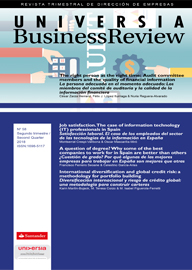
In the first article, professors César Zarza‑Herranz, Félix J. López‑Iturriaga, from the University of Valladolid, and Nuria Reguera-Alvarado (University of Seville) analyse the relationship between some of the personal characteristics of the members of the audit committee of Spanish listed companies and results-based management. For the authors, the results show a non-linear relationship with seniority on the board: while in the early stages a longer duration can compromise the independence of the directors, there comes a point when seniority on the committee increases their experience. Being part of an overly high number of boards results in less ability of the directors to detect results-based management. Higher educational qualifications and more diverse professional experience contribute to improving the quality of financial information.
The dissatisfaction of workers has a great impact on organisations and can have a direct effect on profitability and quality of the goods or services provided. Professors Montserrat Crespi-Vallbona and Oscar Mascarilla-Miró (University of Barcelona) analyse different variables that determine well-being at work. Based on a survey of 4207 IT professionals, this article examines the importance of job content, team climate, leadership, recognition and compensation, physical working conditions and personal working conditions as key aspects of employee satisfaction. The results conclude that the job description is the first aspect that employees value in their satisfaction rate. Physical working conditions and leadership are the least significant variables.
Multiple national and international rankings select a subset of companies in a country or the world as the best to work for. Despite this uniformity, the scores they obtain in the indexes on which the rankings are based are not the same. Professors Francisco Ferreiro Seoane and Celestino García-Arias (University of Santiago de Compostela) try to find out if the differences between the scores obtained by the companies considered the best to work for in Spain can be explained through contextual factors. For the authors, the results of the analysis show that the scores of the companies tend to increase with their size and with value; they differ between autonomous communities and they do not differentiate between nations/economic-cultural areas of origin nor between sectors of activity.
In the following article, Professors Karin Martín-Bujack, M. Teresa Corzo and Isabel Figuerola-Ferretti (Pontificia Comillas University) offer a methodology to form a portfolio of equity investments with exposure to global credit risk and controlled market risk. Following a methodology of factor breakdown, the authors reduce the sample of the largest international companies to a portfolio with only 11 shares, representing different risk factors, which show a high diversification in terms of systematic risk and a risk-return binomial that is comparable to the main international equity indices.
I encourage you to read all the articles. We hope to continue to have everyone's trust: Associate Editors, members of the Scientific Committee, Editorial Board, evaluators, author-collaborators, companies and above all the readers from both the University and the business world. We welcome the Camilo José Cela University as the new publishing company and we are looking forward to this new challenge and are ready to improve the inherited legacy.
Published: 2018-06-06