.png)
The “H Index of Spanish Scientific Journals according to Google Scholar Metrics (2011-2015)” has recently been published in the third quarter of 2016, revealing that Universia Business Review ranks first among the 87 journals analysed in the field of ECONOMY and COMPANIES. The publication’s leading status is also confirmed by the findings of one of the relative quality indices on which Universia Business Review is indexed: SCOPUS (Elsevier Bibliographic Databases. Scimago Journal Rank 2015 (SJR) :0,219 Q2; Category: Business, Management and Accounting (miscellaneous). We are now, therefore, embarking on the process of being reassessed by the Social Science Citation Index and we are confident that our journal will once again be accepted before too long.
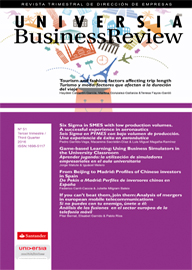
In the first article, the authors discuss possible correlations between tourism and buying, paying particular attention to how shopping for fashion products might influence our travel choices. The concept of cognitive and hedonic involvement allows us to relate the perceived importance of buying by consumers of fashion products with tourism. Professors Haydeé Calderón-García, Martina Gonzalez-Gallarza and Teresa Fayos-Gardó (University of Valencia) analyse whether the act of buying fashion products by the tourist affects the duration of the trip or holiday. They also investigate whether the length of the trip is influenced by classic demographic factors (age, gender and level of income), along with other factors relating to buying behaviour at fashion establishments (quality of service, product quality, and buying enjoyment). The empirical study involved a sample of 370 tourists and offers some interesting conclusions for tourism management purposes by revealing that involvement with fashion, buying enjoyment, quality of service, cognitive involvement in selecting the destination, age and income all shape the length of the trip.
Six Sigma is currently one of the most powerful tools when it comes to improving quality. Originally designed for highly repetitive, high-output production processes, it has been adopted by many of the world’s largest organisations across a wide spectrum of sectors. Professors Pedro Garrido-Vega, Macarena Sacristán-Díaz and Luis Miguel Magaña-Ramírez (University of Seville) explore how this set of techniques can be applied at SMEs, which have relatively low production outputs, while attempting to identify the main success factors and hurdles to implementing the system. In doing so, they employ the “research to action” methodology at an SME from the aeronautical sector, applying the DMAIC improvement cycle to a specific Six Sigma project. Their results reveal that it can be applied and suggest that whether or not this is successful will ultimately hinge on certain key factors such as team commitment, resource availability and prior training.
Technological progress has allowed education to evolve in tandem by providing innovative teaching aids to improve the learning experience for individuals. Business simulation games are one such aid to active and experiential learning. These new educational tools allow us to improve the student’s motivation, autonomy and control over his or her learning process. In her article, professor Iguácel Melero (University of Zaragoza) aims to analyse the degree of success in implanting a subject based on a business simulation game, by studying the student’s learning experience through that game. Her findings reveal that the support received from teaching staff, plus the enjoyment and enthusiasm experienced by the student while playing the simulator are all particularly strong factors positively shaping the student’s opinion of this ground-breaking educational aid.
In the following article, Federico Carril-Caccia and Juliette Milgram Baleix (University of Granada) study the profile of Chinese investors in Spain by using company-level information and primary data obtained through a questionnaire targeting the manufacturing, renewable energies and distribution sectors. For the authors, Chinese companies in the manufacturing sector are seeking to acquire and develop new capacities and to penetrate not only the Spanish market but also other markets both within and outside the EU. In the field of renewable energies, investors are also geared towards exports, yet in contrast to other sectors they are particularly attracted by highly skilled Spanish labour. Chinese companies engaged in distribution are most swayed by domestic demand: they are looking to acquire new capacities, increase exposure for their brand and support their exports to Spain. They conclude that the study may be useful for those wishing to understand the strategy of these new investors in the Spanish market and the associated risks and opportunities.
The maturity stage of an industry life cycle tends to generate concentration processes as a natural response to increasingly fierce levels of competition. A prime example here is the mobile telephony sector, in which we have seen a large number of mergers in recent years now that the industry has reached maturity. Although there is ample evidence of concentration processes in other more traditional sectors, far fewer studies have explored the phenomena in the still relatively young mobile telecommunications sector. In their recent study, professors Pilar Bernal, Elisabet Garrido and Pablo Ríos (University of Zaragoza) aim to shed further light on the matter, evaluating the potential of domestic mergers as a valuable means of increasing the competitiveness of telecoms operators in the long term. Existing analyses within the wider context of European industry reveal that merger operations have had a clear impact on competition in the long run, on top of the immediate effects on the market power of the companies involved. It has been shown that mergers effectively slowed down the increasing levels of competition we saw from 2000 to 2015, and this is down, among other factors, to the arrival of new competitors and the efforts being made by the market regulator.
Last but not least, I would like to thank Universia once again for its ongoing trust and for the hard work of the Division Editors, the members of the Scientific Committee, Editorial Board and reviewers.Published: 2016-09-23