.png)
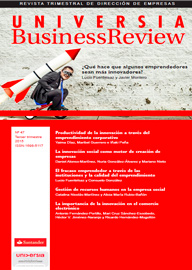
WHAT MAKES SOME ENTREPRENEURS MORE INNOVATIVE?
Article Sidebar
Main Article Content
Abstract
Article Details
Section
How to Cite
References
Agarwall, R., Audretsch, D. y Sarkar, M.B. (2007): “The process of creative construction: knowledge spillovers, entrepreneurship, and economic growth”. Strategic Entrepreneurship Journal, 1, 263-286.
Baumol, W.J. (1990): “Entrepreneurship: Productive, unproductive and destructive”. Journal of Political Economy, 98(5), 893-921.
Baumol, W.J. (2002): The free-market innovation machine: analyzing the growth miracle of capitalism. Princeton, N.J.: Princeton University Press.
Cliff, J.E., Jennings, P.D. y Greenwood, R. (2006): “New to the game and questioning the rules: the experiences and beliefs of founders who start imitative versus innovative firms”. Journal of Business Venturing, 21(5), 633-663.
Dau, L.A. y Cuerzo-Cazurra, A. (2014): “To formalize or not to formalize: Entrepreneurship and pro-market institutions”. Journal of Business Venturing, 29, 668-686.
Estrin, S., Korosteleva, J. y Mickiewicz, T. (2013): “Which institutions encourage entrepreneurial growth aspirations?” Journal of Business Venturing, 28, 564-580.
Fuentelsaz, L., González, C., Maícas, J.P., Montero, J. (en prensa). “How different formal institutions affect opportunity and necessity entrepreneurship”, BRQ Business Research Quarterly, DOI: 10.1016/j.brq.2015.02.001.
Jiménez, A., Palmero-Cámara, C., González-Santos, M.J., González-Bernal, J., Jiménez-Eguizábal, J.A. (2015), “The impact of educational levels on formal and informal entrepreneurship”, BRQ Business Research Quarterly 18 (3), 204-212.
Kirzner, I. (1973): Competition and Entrepreneurship. Chicago: University of Chicago Press.
Knight, F. (1921): Risk, Uncertainty, and Profit. Augustus Kelly: New York.
Koellinger, P. (2008): “Why are some entrepreneurs more innovative than others?” Small Business Economics, 31, 21-37.
Mason, C. y Brown, R. (2013): “Creating good public policy to support high-growth firms”. Small Business Economics, 40, 211-225.
Minniti, M. (2008): “The role of government policy on entrepreneurial activity: productive, unproductive, or destructive?” Entrepreneurship Theory and Practice, 32(5), 779-790.
North, D.C. (1990). “Institutions, Institutional Change and Economic Performance”, Cambridge: Cambridge University Press.
Porter, M. (1990): The Comparative Advantage of Nations, New York: Free Press.
Reynolds, P., Bygrave, W.D., Autio, E., Cox, L.W. y Hay, M. (2003): Global Entrepreneurship Monitor 2002 executive report. Wellesley, MA: Babson College.
Reynolds, P., Bosma, N., Autio, E., Hunt, S., De Bono, N., Servais, I., López-García, P. y Chin, N. (2005): “Global Entrepreneurship Monitor: Data Collection Design and Implementation 1998-2003”. Small Business Economics, 24, 205-231.
Schott, T. y Sedaghat, M. (2014): “Innovation embedded in entrepreneurs´ networks and national educational systems”. Small Business Economics, 43, 463-476.
Schumpeter, J. (1934): The Theory of Economic Development. Harvard University Press: Boston, MA.
Shane, S. (2000): “Prior knowledge and the discovery of entrepreneurial opportunities”. Organization Science, 11(4), 448-469.
Shane, S. (2009): “Why encouraging more people to become entrepreneurs is bad public policy”. Small Business Economics, 33, 141-149.
Shane, S. y Venkataraman, S. (2000): “The promise of entrepreneurship as a field of research”. Academy of Management Review, 25(1), 217-226.
Ucbasaran, D., Westhead, P. y Wright, M. (2009): “The extent and nature of opportunity identification by experienced entrepreneurs”. Journal of Business Venturing, 24, 99-115
Venkataraman, S. (1997): The distinctive domain of entrepreneurship research: an editor´s perspective. In Advances in Entrepreneurship, Firm Emergence, and Growth, J. Katz, R. Crokhaus, eds. JAI Press, Greenwich, CT, pp. 119-138.
Wright, M., Hmieleski, K.M., Siegel, D.S. y Ensley, M.D. (2007): “The role of human capital in technological entrepreneurship”. Entrepreneurship Theory and Practice, 31(6), 791-806.