.png)
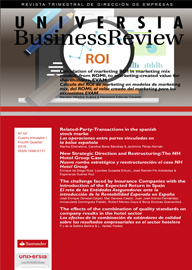
Over the course of the fourth quarter of 2016, we proceeded to replace the seven area editors that make up the Editorial Committee. We would like to thank the seven outgoing area editors for their more than two years of service. They will be joining UBR’s Scientific Committee. Their dedication, skill and academic worth have allowed us to guarantee the quality of the editorial process. We would also like to thank and welcome the new members of the Editorial Committee as they simultaneously take on this new phase with their inherent rigour and with the excitement and dedication required by a project like UBR.
In the first article Mariano Méndez Suárez (ESICBusiness & MarketingSchool) and Macarena Estevez (Conento) use a real-life example of a consumer product to try and explain the construction of a Marketing Mix model. This is done to illustrate the calculation of return on marketing investment (ROMI) as a profitability metric and how to calculate the economic value added of marketing (EVAM) as a metric for shareholders regarding value creation. The authors propose a new method for estimating the l coefficient of the Adstock model through impulse-response functions. We measure the profitability of short-term advertising and the joint effect of short and long-term advertising by using the brand recognition variable measured via brand tracking over the course of the entire analysed period. The results of the analysis indicate that short-term advertising has a negative return that becomes positive when we bear in mind its combined effect with the brand’s recognition.
Despite the relevance that transactions between related parties (TPs) have acquired over the years in capital markets, there are no preliminary studies that analyse the presence of these types of transactions on the Spanish stock market. As a result, professors Marina Elistratova, Carolina Bona Sánchez and Jerónimo Pérez Alemán from Universidad de Las Palmas de Gran Canaria (Canary Islands’ University of Las Palmas) studied TPs on the Spanish continuous market from 2004 to 2014. The results bring to light a significant presence of TPs, with such transactions appearing in more than half of listed companies on certain years. Additionally, it can be seen that there is a greater use of TPs in larger companies, more concentrated companies, those that are family-controlled, and those that are a part of a pyramid.
In the next article, professors Enrique de Diego, Lourdes Susaeta, José Ramón Pin Arboledas (IESE), and Esperanza Suárez Ruz (ESIC Valencia) analyse the change in course of the NH Hotel Group. As a result of the transformations that have taken place in its competitive circles as well as the effects of the economic crisis, the group needed to look ahead by implementing a strategic plan and restructuring its business portfolio. The authors expose the stages that NH went through when implementing said plan and present the positive change it has undergone as they analyse the company’s historic evolution through an analysis of secondary sources. For the authors, the case of the NH Hotel Group supports the statement that the definition and execution of an appropriate strategic plan helps improve business results. Furthermore, flexibility in implementing said plan is equally important in order to be able to adapt to possible changes in the environment.
The inclusion of the Expected Profitability inSpain’s insurance regulation can be considered an important milestone in improving the transparency of the insurance system. Its addition it will allow for comparisons to be carried out, in terms of profitability, between insurance products offered by different entities. One of the goals of this work – written by José Enrique Devesa Carpio; Mar Devesa Carpio; (Polibienestar and University of Valencia); Juan José Alonso Fernández (University of Extremadura); Inmaculada Domínguez Fabián (Polibienestar and University of Extremadura) Robert Meneu (University of Valencia) and Borja Encinas Goenechea (Polibienestar and University of Extremadura) – is to propose the methodology that should be followed in its calculation, such that this indicator can fulfil its main purpose: to compare different insurance policies. The second contribution of the work will allow for an analysis of the impact that the change in the premium’s value has on Expected Profitability, such that this can be transformed into a new element to be considered by insurance entities.
The quality standards have developed significantly in the service sectors, particularly in the tourism industry. The proliferation of different types of standards with vastly different focuses has subjected the hotel industry to a high degree of uncertainty with regard to its decisions about the most advisable quality certification system. That’s why there are so many works that associate the different quality standards with the financial performance of hotel companies. Professors Francisco Javier de la Ballina Ballina and Luis Valdés Peláez ofUniversityofOviedohave gone a step further by raising the possible existence of synergies between the different standards, which would help management and the certifying bodies to administer the different quality standards in a coordinated and organised fashion. The work specifically proposes the resource of the Q regulation of Spanish Tourism Quality as the foundation on which to build an effective quality plan for hotel companies.
Lastly, I cannot conclude this letter without once again thanking Universia for its trust and the work performed by the Area Editors, the members of the Scientific Committee, the Editorial Board and the reviewers.
Published: 2016-12-13