.png)
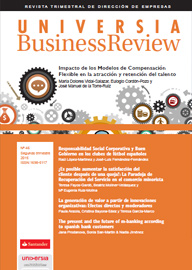
In today’s challenging economic times, many companies support more competitive, innovative and creative organisational and remuneration models. In the first article, professors María Dolores Vidal Salazar, Eulogio Cordón Pozo and José Manuel de la Torre Ruiz (University of Granada) elaborate on Flexible Compensation Models, highly personalised and highly flexible indirect remuneration formulas specifically designed to improve salary efficiency. These systems make employees stakeholders in designing the composition of their remuneration packages and lead to optimising their net remuneration through adequate tax planning without increasing personnel costs. A total of 328 human resources managers at companies located in Spain participated in the research, which analyses the effects of applying these models to organisations’ ability to attract and retain talent.
CSR-based policies have resulted in a new understanding of organisations – not only do they have to maximise their return on assets, but they also have to be socially responsible. For its part, the level of significance reached by football in recent decades has turned this activity into a powerful socio-economic phenomenon that transcends purely sporting consideration. For professors Raúl López Martínez and José Luis Fernández Fernández (Universidad Pontificia de Comillas) one of its fundamental elements – the clubs, have become genuine companies that, in many cases, are not managed in accordance with the legal and ethical imperatives that govern other companies and organisations. The authors raise the debate on applying such practices to the clubs so that they have an impact on improving their corporate governance structures as well as their reputation, and ultimately contributing to creating a country brand image.
There is little, and at times contradictory, research on whether the Service Recovery Paradox is true. The aim of the following article is to verify whether this paradox is true in the retail sector and to analyse how it changes according to the customer’s socio-demographic characteristics and their shopping experience. By studying a sample of customers who were satisfied with the outcome of their complaint, professors Teresa Fayos Gardó, Beatriz Moliner Velázquez and María Eugenia Ruiz Molina conclude that it is not true in this context and that the difference between satisfaction before and after the problem is related to those characteristics.
Studies devoted to innovation management and its effect on business performance feature heavily in the organisational literature of recent years. However, the positive impact of innovation is not only restricted to technological innovation practices. In the following articles, professors Paula Anzola Román, Cristina Bayona Sáez and Teresa García-Marco (Universidad Pública de Navarra) analyse how companies generate value through organisational innovation practices. The authors use a case study to analyse the organisational innovation process carried out by a company and show how the derived implications contributed to creating value, and address both the direct impact and the joint impact of organisational and technological innovation.
The introduction of new technologies in the banking sector has led to significant progress by introducing new channels in the multi-channel environment, such as mobile banking. Professors Jana Prodanova, Sonia San-Martín and Nadia Jiménez Torres propose a mobile banking customer characterisation according to their opinions, perceptions and motivations for using it. They can apply it to both business owners and company executives who already operate in the mobile banking sector and/or those companies that would like to introduce their business in that channel as a complement to the offline or/and online channel. According to the authors, this characterisation can help them choose their target market, personalise the offer to their current and/or potential customers and improve their overall activity in the mobile banking channel.
I do not want to conclude without again thanking Universia for their confidence and the work carried out over the last period by the Associate Editors, the members of the Scientific Committee, Editorial Board and evaluators.
Published: 2015-06-15