.png)
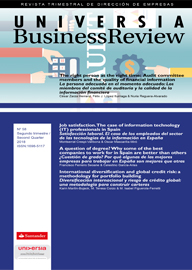
JOB SATISFACTION. THE CASE OF INFORMATION TECHNOLOGY (IT) PROFESSIONALS IN SPAIN
Article Sidebar
Main Article Content
Abstract
Different variables are involved in job satisfaction. Based on a survey of 4207 IT professionals, this paper pays attention to the importance of job position, teamwork atmosphere, leadership, recognition and compensation, physical labor conditions and personal labor conditions as key aspects of employees' well-being. The results show that job position content is the first aspect that employees base their satisfaction rank on. Physical labor conditions and leadership are the least significant variables.
Article Details
Section
How to Cite
References
Alexander, J. A., Lichtenstein, R. L., Oh, H. J., & Ullman, E. (1998). A causal model of voluntary turnover among nursing personnel in long-term psychiatric settings. Research in Nursing & Health, 21(5), 415-427.
Arnett, D.B., Laverie, D.A & McLane, C. (2002). Using job satisfaction and pride as internal marketing tools. Cornell Hotel and Restaurant Administration Quarterly, 43 (2), 87-96.
Avolio, B. and Bass, B. (2004). Multifactor leadership questionnaire. Manual and sampler set. Mind Garden, Inc. Publisher
Bass, B.M. (1985), Leadership and Performance beyond Expectations, Free Press, New York, NY
Benjamin, D.J., Heffetz, O., Kimball, M.S. and Szembrot, N. (2014). Beyond Happiness and Satisfaction: Toward Well-Being Indices Based on Stated Preference. American Economic Review, 104 (9), 2698–2735
Breevaart, K., Bakker, A., Hetland, J., Demerouti, E., Olsen, O. and Espevik, R. (2014), Daily transactional and transformational leadership and daily employee engagement, Journal of Occupational & Organizational Psychology, 87 (1), 138-157
Burns, J.M. (1978), Leadership, Harper and Row, New York, NY
Card, D., Mas, A., Moretti, E. and Saez, E. (2012). Inequality at work: the effect of peer salaries on job satisfaction?. American Economic Review, 102 (6), 2981–3003
Ciulla, J. B. (Ed.) (2004). Ethics, the heart of leadership.Westport, CT: Praeger.
Clark, A.E. and Oswald, A.J. (1996). Satisfaction and comparison income?. Journal of Public Economics, 61 (3), 359–381
Demmy, T.L., Kivlahan, C. and Stone, T.T. (2002), Physicians’ perceptions of institutional and leadership factors influencing their job satisfaction at one academic medical center, Academic Medicine, 77 (12), 1235-1240
Dulewicz, V., & Higgs, M. (2005). Assessing leadership styles and organisational context. Journal of Managerial Psychology, 20(2), 105–123
Eisenberger, R.; Huntington, R.; Hutchison, S., and Sowa, D. (1986), Perceived organizational support. Journal of Applied Psychology, 71 (3), 500-507
Fisher, C. (2010), Happiness at work, International Journal of Management Reviews, 12 (4), 384-412
George, J. and Jones, G. (1997), Experiencing work: values, attitudes, and moods, Human Relations, 50 (4), 393-416
Greenhaus, J.H., Collins, K.M., & Shaw, J.D. (2002). The relation between work-life balance and quality of life. Journal of Vocational Behavior, 63(3), 510-531.
Hakanen, J.J., Schaufeli, W.B. and Ahola, K. (2008), The job demands-resources model: a three-year cross-lagged study of burnout, depression, commitment, and work engagement, Work & Stress, 22 (3), 224-241
Hamermesh, D.S. (2001). The Changing Distribution of Job Satisfaction. Journal of Human Resources, 36 (1), 1–30
Ilies, R., Wilson, K. and Wagner, D. T. (2009), The Spillover of Daily Job Satisfaction onto Employees' Family Lives: The Facilitating Role of Work-Family Integration, Academy of Management Journal, 52(1): 87-102.
Limbu, Y. B., Jayachandran, C., and Babin, B. J. (2014). Does information and communication technology improve job satisfaction? The moderating role of sales technology orientation. Industrial Marketing Management, 43 (7), 1236-1245.
Locke, E.A. (1976), “The nature and causes of job satisfaction”, 1297-1343, in Dunette, M.D. (Ed.), Handbook of Industrial and Organizational Psychology, Rand McNally, Chicago, IL
Macey, W.H. and Schneider, B. (2008), The meaning of employee engagement, Industrial and Organizational Psychology, 1 (1), 3-30
Meneghel, I., Salanova, M., and Martínez, I. M. (2016). Feeling good makes us stronger: How team resilience mediates the effect of positive emotions on team performance. Journal of Happiness Studies, 17 (1), 239-255.
Meyer, J.P. and Allen, N.J. (1997), Commitment in the Workplace, Sage, Thousand Oaks, CA
Moorman, R.H. (1993), The influence of cognitive and affective based job satisfaction measures on the relationship between satisfaction and organizational citizenship behavior, Human Relations, 46 (6), 759-776.
Nemani, R. and Diala, I. (2011), Job Satisfaction: Key Factors Influencing Information Technology (IT) Professionals in Washington DC. ICTA, International Journal of Computer Technology and Applications, 2 (4), 827-838
Nicholson, N., & de Waal-Andrews, W. (2005). Playing to win: Biological imperatives, self‐regulation, and trade‐offs in the game of career success. Journal of Organizational behavior, 26 (2), 137-154
Porath, C.L. and Pearson, C.M. (2010), The cost of bad behavior, Organizational Dynamics, 39 (1), 64-71
Qasim, S., Cheema, F. E. A., & Syed, N. A. (2012). Exploring factors affecting employees' job satisfaction at work. Journal of Management and Social Sciences, 8 (1), 31-39.
Salas, E. and Kozlowski, S. (eds) (2009), Learning, Training and Development in Organizations. London, UK: Routledge Academic
Salas-Vallina, A. López-Cabrales, A., Alegre, J. And Fernández, R. (2017). On the road to happiness at work (HAW). Transformational leadership and organizational learning capability as drivers of HAW in a healthcare context. Personnel Review, 6 (2), 314-338
Schaufeli, W.B. and Bakker, A.B. (2004), Job demands, job resources, and their relationship with burnout and engagement, Journal of Organizational Behavior, 25 (3), 293-315.
Smith, P. C. , Kendall, L. M., and Hulin, C. L. (1969), The Measurement of Satisfaction
in Work and Retirement. Chicago: Rand McNally.
Spector, P. E. (1985), "Measurement of Human Service Staff Satisfaction: Development
of the Job Satisfaction Survey", American Journal of Community Psychology, 13, 693-713.
Stone, A.G., Russell, R.F. and Patterson, K. (2004), Transformational leadership versus servant leadership: a difference in focus, Leadership & Organization Development Journal, 25 (4), 349-361.
Tannenbaum, S. (2002), A Strategic View of Training and Learning” 10-52, in Kraiger, K. (ed), Creating, Implementing and Managing Effective Training and Development: State-of-the-Art Lessons for Practice. San Francisco: Jossey-Bass.
Tims, M., Bakker, A.B. and Xanthopoulou, D. (2011), “Do transformational leaders enhance their followers' daily work engagement?, The Leadership Quarterly, 22 (1), 121-131.
Warr, P. (2007), Work, Happiness, and Unhappiness, Lawrence Erlbaum, NJ.
Weiss, D. J. , Dawis, R. V. England, G. W. and Lofquist, L. H. (1967), Manual for the
Minnesota Satisfaction Questionnaire. Vol. 22, Minnesota Studies in Vocational Rehabilitation, Minneapolis: University of Minnesota, Industrial Relations Center.
Yang, J. (2016), Thriving Organizational Sustainability through Innovation: Incivility Climate and Teamwork. Sustainability, 8 (860), 1-12.
Zhu, W., Avolio, B.J. and Walumbwa, F.O. (2009), Moderating role of follower characteristics with transformational leadership and follower work engagement, Group Organization Management, 34 (5), 590-619.