.png)
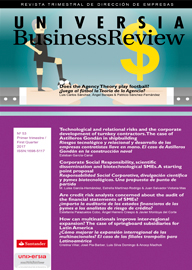
TECHNOLOGICAL AND RELATIONAL RISKS AND THE CORPORATE DEVELOPMENT OF TURNKEY CONTRACTORS. THE CASE OF ASTILLEROS GONDÁN IN SHIPBUILDING
Article Sidebar
Main Article Content
Abstract
Turnkey contractors face a double risk when executing their projects. On the one hand, the risk of failing to meet the requirements of cost, quality, and delivery time agreed with the client. On the other hand, a relational risk caused by the specific investments made by the contractor. Using the case of Astilleros Gondán, SA as empirical evidence, this paper analyzes the role played by project execution capabilities and relational capital in managing the aforementioned risks. Our analysis shows that the key factor when managing these companies is capitalizing on project execution capabilities and relational capital by trying to execute similar projects and/or working with trusted clients.
Article Details
Section
How to Cite
References
Amsden, A. H. y T. Hikino (1994). “Project Execution Capability, Organizational Know-How and Conglomerate Corporate Growth in Late Industrialization”. Industrial and Corporate Change 3(1), 111-147.
Ariño, A. y De La Torre, J. (1998). “Learning from failure: Towards an evolutionary model of collaborative ventures”. Organization Science, 9, 306-325
Axelrod, R. (1984). The evolution of cooperation. New York: Basic Book
Buckley, Peter J. y Mark Casson (1988). “A theory of co-operation in international business” en Cooperative strategies in international business. F. Contractor and P. Lorange (eds), 31–53. Lexington, MA: Lexington Books.
Cho, D. S. y M. E. Porter (1986). “Changing global industry leadership: The case of shipbuilding”, en Porter M. E. (ed.) (1986). Competition in Global Industries, Harvard Business School Press, Boston, 539-567.
Colli, A., E. García-Canal y M. F. Guillén (2013). “Family Character and International Entrepreneurship: A Historical Comparison of Italian and Spanish ‘New Multinationals’.” Business History 55 (1), 119-138.
Davies, A. (2004). "Moving base into high-value integrated solutions: a value stream approach”. Industrial and Corporate Change, 13 (5), 727-756
Davies, A., Brady, T. y Hobday, M. (2007). "Organizing for solutions: Systems seller vs. systems integrator”. Industrial Marketing Management, 36 (2), 183-193.
Davies, A. y Brady, T. (2016). “Explicating the dynamics of project capabilities”. International Journal of Project Management 34 (2), 314-327.
Doz, Y.L. (1996). “The evolution of cooperation in strategic alliances: Initial conditions or learning processes?”. Strategic Management Journal, 17 (sp. issue.), 55-83.
Dyer J. y W. Chu (2003). The role of trustworthiness in reducing transaction costs and improving performance: Empirical evidence from the United States, Japan, and Korea. Organization Science 14(1), 57–68.
Dyer J. y H. Singh (1998). “The relational view: cooperative strategy and sources of interorganizational competi tive advantage”. Academy of Management Review 23: 660-679.
Eccles, R. (1981). "The quasifirm in the construction industry”. Journal of Economic Behavior and Organization, 2: 335-357.
Eisendhart, K.M. (1989). “Building theories from case studies research”. Academy of Management Review, 14 (4), 532-550.
García-Canal, E., Valdés-Llaneza, A. y A. Ariño (2003). “Effectiveness of dyadic and multi-party joint ventures. Organization Studies”. 24, 743-770.
Guillén, M. y E. García-Canal (2010). The New Multinationals: Spanish Firms in a Global Context. New York: Cambridge.
University Press Guisado Tato, M., Vila Alonso, M., y Ferro Soto, C. (2002). “Estado de la cuestión de la construcción naval gallega: los nuevos factores de competitividad”. Revista Galega de Economía 11 (1), 1–21.
Henisz, W. y O. Williamson (1999). “Comparative Economic Organization. Within and Between Countries”. Business and Politics, 1 (3), 261 – 276.
Hobday, M., Davies, A. y Prencipe, A. (2005). “Systems integration: a core capability of the modern corporation”. Industrial and Corporate Change 14 (6), 1109–1143.
Kamuriwo, D.S. y C. Baden-Fuller (2016). “Knowledge integration using product R&D outsourcing in biotechnology”. Research Policy 45, 1031-1045.
Madhok A. y Tallman, S. B. (1998). ‘Resources, transactions and rents: Managing value in interfirm collaborative relationships’. Organization Science, 9, 326-339.
Manning, S. y J. Sydow (2011). “Projects, paths, and practices: sustaining and leveraging project-based relationships”. Industrial and Corporate Change, 20(5), 1369–1402.
Masten, S. E., J. W. Meehan Jr. y E. A. Snyder (1991). “The costs of organization”. Journal of Law, Economics, and Organization, 7: 1-25.
Mesquita, L., y Brush, T.H. (2008). 'Untangling safeguard and production coordination effects in long-term buyer-supplier relationships'. Academy of Management Journal, 51 (4), 785-807.
Ocampo, J. (2016). “Pequeños, familiares y competitivos: astilleros y construcción naval en Asturias (c. 1750-2015)”. Investigaciones de Historia Económica - Economic History Research. http://dx.doi.org/10.1016/j.ihe.2016.07.017
Pavitt, K. (2003). “Specialization and systems integration: Where manufacture and services still meet”, en A. Prencipe, A. Davies, M. Hobday (eds.). The Business of System Integration. Oxford University Press, Oxford, UK, 78-91.
Platero, M. J. (2014). “Astilleros Gondán”. Documento no publicado.
Sánchez Blanco, J. (1992). Crédito social pesquero. Madrid: Ministerio de Agricultura y Pesca.
Swan, J., Goussevskaia A., Newell, S., Robertson, M., Bresnen, M. y Obembe, A. (2007). “Modes of Organizing Biomedical Innovation in the UK and US and the Role of Integrative and Relational Capabilities”. Research Policy 36(4), 529-547.
Valdaliso, J.M. (2005). “La industria de construcción naval y los mercados exteriores durante el Desarrollismo franquista”. VIII Congreso de la Asociación Española de Historia Económica (Santiago de Compostela)
Yin, R. K. (1994). Case study research: Design and methods (2nd ed.) Beverly Hills: Sage.
Williamson, O. E. (1979). "Transaction-Cost Economics: The Governance of Contractual Relations," Journal of Law and Economics, 22, 233-262.