.png)
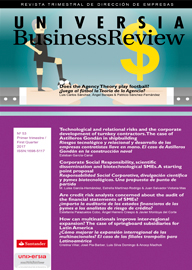
HOW CAN MULTINATIONALS IMPROVE INTER-REGIONAL EXPANSION? THE CASE OF SPRINGBOARD SUBSIDIARIES FOR LATIN AMERICA
Article Sidebar
Main Article Content
Abstract
This article analyses a model of interregional expansion by using springboard subsidiaries. Being located in Spain, these units can facilitate the expansion of multinational companies in Latin America by providing part of the experiential knowledge required to succeed in the region, yet avoiding the initial requirement for investment. Based upon the expansion strategy of five European multinational firms, we develop an inductive model in which headquarters functions –coordination and knowledge creation processes - are distributed between the parent company and the springboard subsidiary along an accumulative process of capabilities. This model reflects the type and degree of commitment of both actors in each stage: whereas in the initial phase the springboard subsidiary and the headquarters act as substitutes, they execute complementary functions with the development of the local network in the target region. By demonstrating how a springboard subsidiary can help to align control to context, the model offers a tool for strategic analysis that helps avoid potential value destruction by parent companies.
Article Details
Section
How to Cite
References
Achcaoucaou, F., Miravitlles, P., and León-Darder, F. (2014). “Knowledge sharing and subsidiary R&D mandate development: A matter of dual embeddedness”. International Business Review, Vol. 23, núm. 1, p. 76-90.
Alfoldi, E. A., Clegg, L. J., and McGaughey, S.L. (2012). “Coordination at the edge of the empire: The delegation of headquarters functions through regional management mandates”. Journal of International Management, Vol. 18, núm. 3, p.276-292.
Ambos, B., and Reitsperger, W. D. (2004). “Offshore centers of excellence: Social control and success” Management and International Review, p. 51-65.
Andersson, U., Forsgren, M. and Holm, U. (2002). “The strategic impact of external networks: subsidiary performance and competence development in the multinational corporation”. Strategic Management Journal, Vol. 23, núm. 11, p. 979-996.
Birkinshaw, J. (1997). “Entrepreneurship in multinational corporations: the characteristics of subsidiary initiatives”. Strategic Management Journal, Vol. 18, núm. 3, p. 207-229.
Birkinshaw, J., Bouquet, C., and Ambos, T. C. (2007). “Managing executive attention in the global company”. MIT Sloan Management Review, Vol. 48, núm. 4, p. 39.
Brenner, B., and Ambos, B. (2013). “A question of legitimacy? A dynamic perspective on multinational firm control”. Organization Science, Vol. 24, núm. 3, p.773-795.
Campbell, A. and Szulanski, G. (2016.) “Knowing when corporate headquarters adds rather than subtracts value”. McKinsey Quarterly, January, p.1-8.
Campbell, A., Goold, M., and Alexander, M. 1995. Corporate strategy: the quest for parenting advantage. Harvard Business Review, Vol. 73, núm. 2, p. 120-132.
Desai, M. A. (2009): “The Decentering of the Global Firm”. The World Economy, Vol. 32, núm. 9, p. 1271-1290.
Forsgren, M., Holm, U., and Johanson, J. (2005). Managing the embedded multinational: A business network view. Edward Elgar Publishing.
Gibbert, M and Ruigrok, W. (2010). “The “What” and “How” of Case Study Rigor: Three Strategies Based on Published Work”. Organizational Research Methods, Vol. 13, núm.4, p. 710-737.
Gioia, D. A., Corley, K. G., and Hamilton, A. L. (2013). “Seeking qualitative rigor in inductive research notes on the Gioia methodology”. Organizational Research Methods, Vol. 16, núm.1, 15-31.
Goold, M., Campbell, A., and Alexander, M. (1998). “Corporate strategy and parenting theory”. Long Range Planning, Vol. 31, núm. 2, p. 308-314.
Gupta, A.K. and Govindarajan, V. (1991) “Knowledge flows and the structure of control within multinational corporations”. Academy of Management Review, Vol. 16, núm. 4, p. 768-792.
Harzing, A. W., and Noorderhaven, N. (2006). “Knowledge flows in MNCs: An empirical test and extension of Gupta and Govindarajan's typology of subsidiary roles”. International Business Review, Vol. 15, núm.3, p. 195-214.
Johanson, J., and Vahlne, J. E. (1977). The internationalization process of the firm-a model of knowledge development and increasing foreign market commitments. Journal of International Business Studies, Vol. 28, núm. 1, p. 23-32.
Johanson, J. and Vahlne, J. E. (2009). “The Uppsala Internationalisation Process Model Revisited: from liability of foreignness to liability of outsidership”. Journal of International Business Studies, Vol. 40, núm. 9, p. 1411-1431.
Lasserre, P. (1996) “Regional headquarters: The spearhead for Asia Pacific markets”. Long Range Planning, Vol. 29, p. 30-37.
Luo, Y., and Tung, R. L. (2007). “International expansion of emerging market enterprises: A springboard perspective”. Journal of International Business Studies, Vol. 38, núm.4, p. 481-498.
Mc Kinsey (2011) “Governance since the economic crisis: McKinsey Global Survey results”. Ed. McKinsey.
Pla-Barber, J., and Camps, J. (2012). “Springboarding: a new geographical landscape for European foreign investment in Latin America.” Journal of Economic Geography, Vol. 12, núm. 2, p. 519-538.
Pla-Barber, J., Villar, C., and Dasí, À. (2014). “La filial trampolín. Una innovación en la empresa multinacional”. Economía Industrial. 391, p. 105-114.
Prahalad, C. K. and Bhattacharyya, H. (2008): “Twenty hubs and no HQ”. Strategy + Business, 50, p. 1-5.
Rugman, A and Verbeke, A. (2008). “A regional solution to the strategy and structure of multinationals”. European Management Journal, Vol. 26, núm. 5, p. 305-313.
White, R. E., and Poynter, T. A. (1984). “Strategies for foreign-owned subsidiaries in Canada”. Business Quarterly, Vol. 49, núm. 2, p. 59-69.
Yin, R. (1981). “The case study crisis: Some answers”. Administrative Science Quarterly, Vol. 26, núm. 1, p. 58-65.
Young, S., and Tavares, A. T. (2004). “Centralization and autonomy: back to the future”. International Business Review, Vol. 13, núm. 2, p. 215-237.