.png)
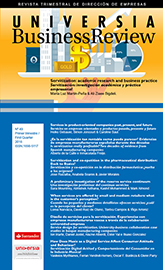
WHEN SERVICES ARE OFFERED BY SMALL AND MEDIUM RETAILERS: WHAT IS THE CUSTOMER’S PERCEPTION?
Article Sidebar
Main Article Content
Abstract
The concept of servitization or adding services to the existing product offer has been mainly used in the manufacturing sector but little or no attention has been paid to the application of this concept in the retail sector. The purpose of this exploratory research is to measure the perceptions that customers have towards local small and medium retailers regarding the services they offer. We also want to compare the profile of the customers that consider products and services the most important factor when choosing a retailer compared to the rest of the sample. Our findings show that there are a few differences between customers who would prefer more services compared to customers who state that services are not their priority.
Article Details
Section
How to Cite
References
Baines, T. S., Lightfoot, H. W., Evans, S., Neely, A., Greenough, R., Peppard, J., et al. (2007). State-of-the-art in product-service systems. Proceedings of the Institution of Mechanical Engineers, Part B: Journal of Engineering Manufacture, 221(10), 1543-1552.
Baines, T. S., Lightfoot, H., & Smart, P. (2011). Servitization within manufacturing: Exploring the provision of advanced services and their impact on vertical integration. Journal of Manufacturing Technology Management, 22(7), 947-954.
Baines, T., & Lightfoot, H. (2013). Made to serve; understanding what it takes for a manufacturer to compete through servitization and product-service systems. Hoboken: Wiley,
Ballantyne, D., &Varey, R.J. (2008), article accepted for the special
issue on the Service-Dominant Logic of Marketing, Journal of the Academy of
Marketing Science (JAMS), 36:1, pp. 11-14.
Barnett, N. J., Parry, G., Saad, M., Newnes, L. B., & Goh, Y. M. (2013). Servitization: Is a paradigm shift in the business model and service enterprise required? Strategic Change, 22(3‐4), 145-156.
F. Bustinza, O., C. Parry, G., & Vendrell-Herrero, F. (2013). Supply and demand chain management: The effect of adding services to product offerings. Supply Chain Management: An International Journal, 18(6), 618-629.
Hewitt, P. (2002). The government's manufacturing strategy. Secretary of State for Trade and Industry, Westminster, 4.
Lusch, R. F., Vargo, S. L., & O’Brien, M. (2007). Competing through service: Insights from service-dominant logic. Journal of Retailing, 83(1), 5-18.
Muller, E., & Doloreux, D. (2007). The Key Dimensions of Knowledge-Intensive Business
Rada, J., & Vandermerwe, S. (1988). Servitization of business: Adding value by adding service. European Management Journal, 6(4), 314-320.
Rosenbloom, B., & Dupuis, M. (1994). Low price, low cost high services, a new paradigm for Global Retailers. The International Journal of Retail.
Sánchez Montesinos, F., & Arias Aranda, D. (2014). La adaptación a la servitización como elemento esencial del futuro de los medios de comunicación de prensa escrita.
Sorescu, A., Frambach, R. T., Singh, J., Rangaswamy, A., & Bridges, C. (2011). Innovations in retail business models. Journal of Retailing, 87, S3-S16.
Vargo, S. L., & Lusch, R. F. (2004). Evolving to a new dominant logic for marketing. Journal of Marketing, 68(1), 1-17.
Vargo, S. L., & Lusch, R. F. (2012). The nature and understanding of value: A service-dominant logic perspective. Review of Marketing Research, 9, 1-12.