.png)
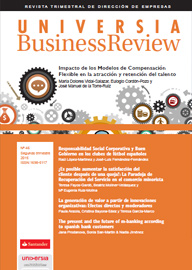
VALUE GENERATION THROUGH ORGANIZATIONAL INNOVATION: DIRECT AND MODERATING EFFECTS
Article Sidebar
Main Article Content
Abstract
Studies devoted to innovation management and its effect on firm performance are among the most fertile fields in organizational literature in recent years. However, the positive impact of innovation is not limited only to technological innovation practices. This article discusses how companies create value through organizational innovation practices. Through an in-depth case study, this paper analyses the organizational innovation process undergone by a firm, illustrating how and to what extent the implications resulting from said process contribute to value generation, addressing both direct effects as well as the combined effect derived from technological and organizational innovations.
Article Details
Section
How to Cite
References
Armbruster, H., Kirner, E., Lay, G., Szwejczewski, M. y Coriat, B. (2007). Patterns of organisational change in european industry (PORCH). ways to strengthen the empirical basis of research and policy.Fraunhofer-Institut für System- und Innovationsforschung, Karlsruhe, European Commission, Directorate-General for Enterprise and Industry, Innovation Policy Unit.
Armbruster, H., Bikfalvi, A., Kinkel, S. y Lay, G. (2008). Organizational innovation: The challenge of measuring non-technical innovation in large-scale surveys. Technovation, 28(10), 644-657.
Battisti, G. y Iona, A. (2009). The intra-firm diffusion of complementary innovations: Evidence from the adoption of management practices by british establishments. Research Policy, 38(8), 1326-1339.
Benbasat, I., Goldstein, D.K. y Mead M. (1987). The case research strategy in studies of information systems. MIS Quarterly, 11(3), 369–386.
Chesbrough, H. (2007). Business model innovation: It's not just about technology anymore. Strategy & Leadership, 35(6), 12-17.
Comisión Europea. (2008). European innovation scoreboard 2007. Comparative analysis of innovation performance. Brussels: Comisión Europea.
Crossan, M. M. y Apaydin, M. (2010). A multi-dimensional framework of organizational innovation. Journal of Management Studies, 47(6), 1154-1191.
Damanpour, F., Walker, R. M. y Avellaneda, C. N. (2009). Combinative effects of innovation types and organizational performance: A longitudinal study of service organizations. Journal of Management Studies, 46(4), 650-675.
Demil, B. y Lecocq, X. (2010). Business model evolution: In search of dynamic consistency. Long Range Planning, 43(2-3), 227-246.
Eisenhardt, K.M. (1989). Building theories from case study research. Academy of Management Review, 14 (4), 532–550.
Ettlie, J. E. (1988). Taking charge of manufacturing: How companies are combining technological and organizational innovations to compete successfully. San Francisco, CA:Jossey-Bass.
Ettlie, J. E. y Reza, E. M. (1992). Organizational integration and process innovation. Academy of Management Journal, 35, 795–827.
Evangelista, R. y Vezzani, A. (2010). The economic impact of technological and organizational innovations. A firm-level analysis. Research Policy, 39(10), 1253-1263.
Fagerberg, J. (1994). Technology and international differences in growth rates. Journal of Economic Literature, 32(3), 1147-1175.
Grossman, G. M. y Helpman, E. (1994). Endogenous innovation in the theory of growth. The Journal of Economic Perspectives, 8(1), 23-44.
Hervás-Oliver, J. L. y Sempere-Ripoll, F. (2014). Disentangling the influence of technological process and product innovations. Journal of Business Research, 68(1), 109-118.
Hervás-Oliver, J. L., Sempere-Ripoll, F. y Boronat Moll C. (2014). Process innovation strategy in SMEs, organizational innovation and performance: a misleading debate? Small Business Economics, 43(4), 873-886.
Hollen, R., Van Den Bosch, Frans A. J, y Volberda, H. W. (2013). The role of management innovation in enabling technological process innovation: An Inter-Organizational perspective. European Management Review, 10(1), 35-50.
Huston, L. y Sakkab, N. (2006). Connect and develop: inside Procter & Gamble’s new model for innovation. Harvard Business Review, 84, 58-66.
Jick, T. D. (1979). Mixing qualitative and quantitative methods: Triangulation in action. Administrative Science Quarterly, 24(4), 602-611.
Laforet, S. (2013). Organizational Innovation Outcomes in SMEs: Effects of Age, Size and Sector. Journal of World Business, 48(4), 490-502.
Marsili, O. y Salter, A. (2006). The dark matter of innovation: Design and innovative performance in dutch manufacturing. Technology Analysis & Strategic Management, 18(5), 515-534.
Mol, M. J. y Birkinshaw, J. (2009). The sources of management innovation: When firms introduce new management practices. Journal of Business Research, 62(12), 1269-1280.
OECD y Eurostat (2005). Oslo manual: Guidelines for collecting and interpreting innovation data. (3rd ed.) OECD Publishing.
Osterwalder, A. y Pigneur, Y. (2010). Business model generation: A handbook for visionaries, game changers and challengers. Hoboken, NJ: Wiley.
Sapprasert, K. y Clausen, T. H. (2012). Organizational innovation and its effects. Industrial and Corporate Change, 21(5), 1283-1306.
Sempere-Ripoll, F. y Hervás-Oliver, J. L. (2014). Innovación tecnológica y no tecnológica: efectos complementarios en la perfomance empresarial. Economía Industrial, 391, 71-76.
Schmidt, T. y Rammer, C. (2007). Non-technological and technological innovation: Strange bedfellows? ZEW - Centre for European Economic Research Discussion Paper no. 07-052.
Shah, R. y Ward, P. T. (2003). Lean manufacturing: Context, practice bundles, and performance. Journal of Operations Management, 21(2), 129-149.
Som, O., Diekmann, J., Solberg, E., Schricke, E., Schubert, T., Jung-Erceg, P., Daimer, S. (2012). Organisational and marketing innovation - promises and pitfalls. INNO-grips II report. Brussels: European Commission, DG Enterprise and Industry.
Tidd, J. (2001). Innovation management in context: Environment, organization and performance. International Journal of Management Reviews, 3(3), 169–183.
Tidd, J. y Bessant, J. (2005). Managing innovation: Integrating technological, market and organisational change. (3rd ed.). Chichester: Wiley.
Voss, C., Tsikriktsis, N. y Frohlich, M. (2002). Case research in operations management. International Journal of Operations & Production Management, 22(2), 195–219.
Yin, R. K. (2003). Case study research: Design and methods. Thousand Oaks, CA: SAGE Publications.
Zott, C., Amit, R. y Massa, L. (2011). The business model: Recent developments and future research. Journal of Management, 37(4), 1019-1042.