.png)
During the second quarter 2016 SCOPUS has published the new index SJR: SCOPUS (Elsevier Bibliographic Databases. Scimago Journal Rank 2015 (SJR): 0,219 Q2; Category: Business, Management and Accounting (miscellaneous), in category position 136 out of 285 and area position 735 out of 1318. We would like to emphasise the Steering Committee’s commitment to remaining indexed in the main international databases and that the UBR continues to be considered a quality scientific journal. This commitment to quality has enabled the UBR to be granted the EXCELLENT journal certificate by the Spanish Foundation for Science and Technology, Ministry of Science and Innovation (FECYT). For this reason, we have initiated the process of being re-evaluated by the Social Science Citation Index and are confident that the journal will soon be readmitted.
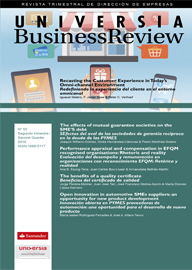
Let us start off by discussing how omnichannel marketing can help improve both customer experience and customer performance. For professors Iguacel Melero, Javier Sese (University of Zaragoza) and Peter C. Verhoef (University of Groningen), the concept has become a cornerstone of marketing strategy, yet putting it into practice remains one of the main challenges facing companies today. The authors analyse how companies can comprehensively manage all points of contact across all channels so as to provide an enhanced customer experience and thus improve their competitive edge. In doing this, they flag a series of key questions that companies must first address before rolling out the changes that their organisations need in order to reshape the customer experience and ensure superior levels of performance. These include the need to adopt a customer-oriented focus, unify all points of contact across all channels, ensure personalised experiences for each and every customer, integrate available channels, cater to customers across all channels, rethink the role played by physical stores and outlets and commit themselves to mobile marketing.
In the following article, Joaquín Miñarro-Gómez (BMN, Risks Analysis Levante), Ginés Hernández-Cánovas (Polytechnic University of Cartagena) and Pedro Martínez-Solano (University of Murcia) will attempt to analyse how posting a guarantee through a Mutual Guarantee Society (Sociedad de Garantía Recíproca) can affect borrowing cost and loan availability for small- and medium-sized enterprises. In doing so, they analyse a sample of SMEs that received such a guarantee in 2010. Their findings reveal that SMEs that obtained a guarantee from a Mutual Guarantee Society generally had an easier time securing bank financing than those that chose a different path to financing their business.
In the third article, professors Ana B. Escrig-Tena, Juan Carlos Bou-Llusar and Inmaculada Beltrán-Martín (University Jaume I) attempt to answer the following key questions: what employee performance and remuneration assessment systems are used by companies geared towards quality management and excellence? Is there a prevailing pattern among these organisations? The authors present the results of an empirical study conducted on a sample of 180 Spanish companies that have an excellence recognition system in place under the EFQM model. The findings reveal that only one group of companies employs performance and remuneration assessment systems that are geared towards development and, therefore, aligned with what experts on the subject of quality management view as the right approach to follow. The authors also spotted other types of systems where the assessment of performance and remuneration is improperly matched, as well as systems focused on attaining objectives.
The aim of the following article is to show the benefits of internalising the requirements of a quality-based rule. By interviewing senior figures from the tourism sector and conducting a quantitative study, Jorge Pereira-Moliner, Juan José Tarí, José Francisco Molina-Azorín and María Dolores López-Gamero (University of Alicante) conclude that results can be improved by internalising quality rules and standards. By becoming more committed to implementing quality requirements, tourism companies can effectively improve their management system because they will be applying quality requirements through a more advanced model. This means that companies that genuinely believe in the concept of quality and apply it in their day-to-day business can improve their results.
We will finish off with an article that seeks to analyse open innovation practices that can be implemented by service-provider SMEs operating in the auto industry. Professors María Isabel Rodríguez Ferradas and José Antonio Alfaro Tanco (University of Navarra) use the results of a multiple case study to show how useful innovation practices can be in responding to changing market needs and remaining competitive. The authors go on to provide a detailed discussion of one of these practices that can help systematise the process of developing new products: co-developments.
Last but not least, I would like to thank Universia once again for its ongoing support and express my appreciation for all the hard work of the division editors, the members of the Scientific Committee, the Editorial Board and evaluators in the period leading up to this edition.
José Ignacio López
Editor in Chief of UBRPublished: 2016-06-17