.png)
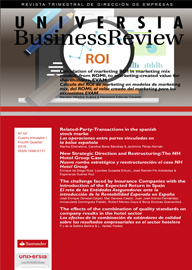
RELATED-PARTY-TRANSACTIONS IN THE SPANISH STOCK MARKET
Article Sidebar
Main Article Content
Abstract
Despite the relevance of related-party transactions (RPTs) in the capital markets, empirical evidence on RPTs is absent in the Spanish capital market. Thus, in the current work we provide novel evidence on the configuration of RPTs for Spanish listed firms along the period 2004-2014. Our results show a significant presence of RPTs, with more than half of listed Spanish firms committing to RPTs. Moreover, our results show that RPTs are greater in large-cap companies, in companies with higher ownership concentration, in firms effectively controlled by a family and in those companies where controlling owners’ voting-cash flow wedge is higher.
Article Details
Section
How to Cite
References
Anderson, R.C. y Reeb, D.M. (2003) "Founding-Family Ownership and Firm Performance: Evidence from the S&P 500", 58 (3), 1301-1328. http://dx.doi.org/10.2139/ssrn.303864
Bebchuk, L. A. (1999). A Rent-Protection Theory of Corporate Ownership and Control. National Bureau of Economic Research, (WP 7203).
Berle, A. A., y Means, G. C. (1932). "The Modern Corporation and Private Property". Macmillan Publishing Company (Vol. 21). http://doi.org/10.2307/3475545
Bona Sánchez, C., Pérez Alemán, J., y Santana Martín, D. J. (2013). Dominant institutional control and earnings informativeness. Revista Española De Financiación y Contabilidad, 42(159), 371–394. http://dx.doi.org/10.1080/02102412.2013.10779751
Bona-Sánchez, C., Pérez-Alemán, J., y Santana-Martín, D. J. (2014). Politically connected firms and earnings informativeness in the controlling versus minority shareholders context: European evidence. Corporate Governance (Oxford), 22(4), 330–346. http://dx.doi.org/10.1111/corg.12064
Burkart, M., Panunzi, F., y Shleifer, A. (2003). Family firms. Journal of Finance, 58(5), 2167–2201. http://doi.org/10.1111/1540-6261.00601
Chang, S. J., y Hong, J. (2000). Economic performance of group-affiliated companies in Korea: Intragroup resource sharing and internal business transactions. Academy of Management Journal, 43(3), 429–448. http://doi.org/10.2307/1556403
Cheung, Y. L., Rau, P. R., y Stouraitis, A. (2006). Tunneling, propping, and expropriation: evidence from connected party transactions in Hong Kong. Journal of Financial Economics, 82(2), 343–386. http://doi.org/10.1016/j.jfineco.2004.08.012
Coase, R. H. (1937). "The Nature of the Firm". Retrieved June 21, 2015, from http://www.jstor.org/stable/2626876?seq=1#page_scan_tab_contents
de Miguel, A., Pindado, J., y de la Torre, C. (2005). How do entrenchment and expropriation phenomena affect control mechanisms? Corporate Governance-an International Review, 13(4), 505–516. http://doi.org/10.1111/j.1467-8683.2005.00445.x
Duprey, R. (2006). The Minefield of Related-Party Transactions. Retrieved February 21, 2015, from http://www.fool.com/investing/general/2006/04/27/the-minefield-of-relatedparty-transactions.aspx
Faccio, M., y Lang, L. H. P. (2002). The ultimate ownership of Western European corporations. Journal of Financial Economics, 65(3), 365–395. http://doi.org/10.1016/S0304-405X(02)00146-0
Gordon, E. A., Henry, E., y Palia, D. (2004). Related Party Transactions and Corporate Governance. Advances in Financial Economics, 9, 1-27. http://doi.org/10.1016/S1569-3732(04)09001-2
Grossman, S. J., y Hart, O. D. (1988). One share-one vote and the market for corporate control. Journal of Financial Economics, 20, 175-202. http://doi.org/10.1016/0304-405X(88)90044-X
Jensen, M. C., y Meckling, W. H. (1976). Theory of the Firm : Managerial Behavior , Agency Costs and Ownership Structure Theory of the Firm : Managerial Behavior , Agency Costs and Ownership Structure. Journal of Financial Economics, 3(4), 305–360. http://doi.org/http://dx.doi.org/10.1016/0304-405X(76)90026-X
Jian, M., y Wong, T. J. (2010). Propping through related party transactions. Review of Accounting Studies, 15(1), 70–105. http://doi.org/10.1007/s11142-008-9081-4
Jiang, G. H., Lee, C. M. C., y Yue, H. (2010). Tunneling through intercorporate loans: {The} {China} experience. Journal of Financial Economics, 98(1), 1–20. http://dx.doi.org/10.1016/j.jfineco.2010.05.002
Khanna, T., y Palepu, K. (2000). Is Group Affiliation Profitable in Emerging Markets? An Analysis of Diversified Indian Business Groups. The Journal of Finance, 55(2), 867–891. http://doi.org/10.1111/0022-1082.00229
La Porta, R., Lopez-de-Silanes, F., Shleifer, A., y Vishny, R. (2000). Investor protection and corporate governance. Journal of Financial Economics,58(1-2), 3-27. http://dx.doi.org/10.1016/s0304-405x(00)00065-9
La Porta, R., Lopez-de-Silanes, F., Shleifer, A., y Vishny, R. W. (1998). Law and finance. Journal of Political Economy, 106(6), 1113–1155. http://dx.doi.org/10.1086/250042
Morck, R., Wolfenzon, D., y Yeung, B. (2005). Corporate Governance, Economic Entrenchment, and Growth. Journal of Economic Literature, 43(3), 655-720. http://doi.org/10.1257/002205105774431252
Pennings, J. M., y Williamson, O. E. (1979). Markets and Hierarchies: Analysis and Anti-trust Implications: A Study of the Economics of Internal Organization. Contemporary Sociology, 8(1), 57-60. http://doi.org/10.2307/2064894
Santana-Martín, D. (2010). Los pactos parasociales en la Bolsa Española/Shareholders Coalitions in Spain. Universia Business Review, (28), 46-61 Retrieved from http://search.proquest.com/openview/980f91089479b9821e652a533ec6bc60/1?pq-origsite=gscholar
Stein, J. C. (1997). Internal capital markets and the competition for corporate resources. Journal of Finance, 52(1), 111–133. http://doi.org/10.2307/2329558
Studenmund, A. H. (1997)Using Econometrics: A Practical Approach(Reading, MA: Addison-Wesley).
Villalonga, B., y Amit, R. (2006). How do family ownership, control and management affect firm value? Journal of Financial Economics, 80(2), 385–417. http://doi.org/10.1016/j.jfineco.2004.12.005