.png)
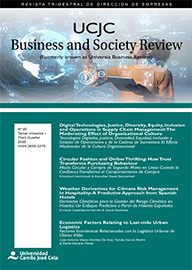
Derivados Climáticos para la Gestión del Riesgo Climático en Hoteles: Un Enfoque Predictivo a Partir de Hoteles Españoles
Barra lateral del artículo
Contenido principal del artículo
Resumen
La climatología influye significativamente en el turismo, y el cambio climático ha incrementado la preocupación por sus posibles impactos futuros. Aunque los estudios sobre gestión del riesgo climático proponen el uso de derivados, como los futuros sobre temperatura, para el sector hotelero, a menudo pasan por alto la viabilidad del mercado. Una cobertura eficaz requiere un mercado accesible y eficiente en costes, lo que depende de su rentabilidad. Este estudio evalúa la viabilidad de un mercado de derivados para que los hoteles españoles puedan cubrir los riesgos climáticos relacionados con la temperatura. Para ello, se analizan datos del periodo 2016-2023 de una selección de ciudades turísticas españolas mediante regresión Elastic Net, con el objetivo de identificar las localizaciones en las que los derivados climáticos resultan más relevantes. Los resultados muestran que los derivados sobre temperatura pueden cubrir eficazmente el riesgo en aquellas ciudades donde el clima tiene una incidencia significativa sobre la ocupación hotelera. El estudio aporta evidencia útil para la gestión del riesgo en el sector hotelero y respalda la creación de mercados de derivados climáticos adaptados al turismo.
Detalles del artículo
Sección
Cómo citar
Referencias
References
AEMET (2023). Valores extremos. España. Agencia Estatal de Meteorología. Madrid.
AEMET (2024). Resúmenes climatológicos. España. Agencia Estatal de Meteorología. Madrid.
Benth, F. E., & Benth, S. (2007).The volatility of temperature and pricing of weather derivatives. Quantitative Finance, 7(5), 553-561.
Sileo E (2012). Managing risk of ski resorts with snow options. AlmaTourism, 3(6), 50-67.
Afshardoost, M., Lohmann, G., Oliveira, G. E., & Moyle, B. (2024). Planning for Weather Variability: Towards an Integrated Conceptual Framework, Tourism Planning & Development, https://doi.org/10.1080/21568316.2024.2432415.
Alaton, P,, Djehiche, B., & Stillberger, D. (2002). On modelling and pricing weather derivatives. Applied Mathematical Finance, 9(1), 1-20.
Alexandridis, A. K., Gzyl, H., ter Horst, E., & Molina, G. (2021). Extracting pricing densities for weather derivatives using the maximum entropy method, Journal of the Operational Research Society, 72(11), 2412-2428.
Amelung, B., Nicholls, S., & Viner, D. (2007). Implications of global climate change for tourism flows and seasonality. Journal of Travel Research, 45(3), 285-296.
Ballotta, L., Fusai, G., Kyriakou, I., Papapostolou, I., & Pouliasis, P. (2019). Risk management of climate impact for tourism operators: An empirical analysis on ski resorts. Tourism Management, 77, 51-63.
Bank, M., & Wiesner, R. (2011). Determinants of weather derivatives usage in the Austrian winter tourism industry. Tourism Management, 32(1), 62-68.
Becken, S. (2013). A review of tourism and climate change as an evolving knowledge domain. Tourism Management Perspectives, 6, 53-62.
Becken, S., & Wilson, J. (2013). The impacts of weather on tourist travel. Tourism Geographies, 15(4), 620-639.
Becken, S., Zammit, C., & Hendrikx, J. (2015). Developing climate change maps for tourism: essential information or awareness raising? Journal of Travel Research, 54(4), 430-441.
Bibi, F., & Rahman, A. (2023). An overview of climate change impacts on agriculture and their mitigation strategies. Agriculture, 13(8), 1508.
Bressan, G. M., & Romagnoli, S. (2021). Climate risks and weather derivatives: A copula-based pricing model. Journal of Financial Stability, 54, 100877.
Canales, P., & Pardo, A. (2011). Assessing weather risk in sun and sand destinations. Environmental Economics, 2(1), 50-61.
Campbell, S. D., & Diebold, F. X. (2002). Weather forecasting for weather derivatives. Journal of the American Statistical Association, 100(469), 6-16.
CME (2024). Weather Futures and Options. Manage Risk Associated with Fluctuating Global Temperatures. Chicago Mercantile Exchange, Chicago, IL.
Coghlan, A., & Prideaux, B. (2009). Welcome to the Wet Tropics: the importance of weather in reef tourism resilience. Current Issues in Tourism, 12(2), 89-104.
Craig, C. A. (2023). Nature-based tourism and climate favourability: a case of the Great Barrier Reef, Australia. Tourism Recreation Research, 1-11.
Craig, C. A., & Feng, S. (2018). A temporal and spatial analysis of climate change, weather events, and tourism businesses. Tourism Management, 67, 351-361.
Craig, C. A., & Ma, S. (2022). Weather and recreational vehicle camping businesses. Annals of Tourism Research Empirical Insights, 3(2), 100063.
Dawkins, S. S., & Stern, H. (2004). Managing weather risk during major sporting events: the use of weather derivatives. In 2nd International Workshop on Climate, Tourism and Recreation, Orthodox Academy of Crete, Kolimbari, Crete, Greece (pp. 8-11).
Denstadli, J. M., Jacobsen, J. K. S., & Lohmann, M. (2011). Tourist perceptions of summer weather in Scandinavia. Annals of Tourism Research, 38(3), 920-940.
Fang, Y., Yin, J., & Wu, B. (2018). Climate change and tourism: a scientometric analysis using CiteSpace. Journal of Sustainable Tourism, 26(1), 108-126.
Franzoni, S., & Pelizzari, C. (2016). Weather risk management in tourism industry. Emerging Issues in Management, 1, 45-55.
Franzoni, S., & Pelizzari, C. (2019). Rainfall financial risk assessment in the hospitality industry. International Journal of Contemporary Hospitality Management, 31(3), 1104-111121.
Gossling, S., Abegg, B., & Steiger, R. (2016). “It Was Raining All the Time!”: Ex Post Tourist Weather Perceptions. Atmosfera, 7(1), 10.
Hernandez, A. B., & Ryan, G. (2011). Coping with climate change in the tourism industry, Tourism and Hospitality Management, 17(1), 79-90.
Hewer, M. J., Scott, D. J., & Gough, W. A. (2018). Differential temperature preferences and thresholds among summer campers in Ontario’s southern provincial parks: a Canadian case study in tourism climatology. Theoretical and Applied Climatology, 133, 1163-1173.
Hoogendoorn, G., & Fitchett, J. M. (2018). Tourism and climate change: A review of threats and adaptation strategies for Africa. Current Issues in Tourism, 21(7), 742-759.
Huang, J.W., Yang, S.S., & Chang, C.C. (2016). Modeling temperature behaviors: Application to weather derivative valuation. Futures Market, 38(9), 1152-1175.
INE (2024). Estadística de Movimientos Turísticos en Fronteras. Instituto Nacional de Estadística. Madrid.
Jeuring, J. H. G. (2017). Weather perceptions, holiday satisfaction and perceived attractiveness of domestic vacationing in The Netherlands. Tourism Management, 61, 70-81.
Jurgilevich, A., Räsänen, A., Groundstroem, F., & Juhola, S. (2017). A systematic review of dynamics in climate risk and vulnerability assessments. Environmental Research Letters, 12(1), 013002.
Kobert, J., Prettenthaler, F., & Bird, N. D. (2016). Modelling climate change on tourism demand: A comparative study from Sardinia (Italy) and Cap Bon (Tunisia). Science of the Total Environment, 543, 1039-1053.
Kramer, C. S. (2023). Place production, urban tourism geographies and experiences of Muße. Tourism Geographies, 25(4), 969-983.
Leggio, K. B. (2007). Using weather derivatives to hedge precipitation exposure. Managerial Finance, 33(4), 246-252.
Lin, X., & Kwon, W. J. (2020). Application of parametric insurance in principle‐compliant and innovative ways. Risk Management and Insurance Review, 23(2), 121-150.
Liu, W. Y, Huang, Y. H., & Hsieh, C. M. (2020). The Impacts of Different Climate Change Scenarios on Visits toward the National Forest Park in Taiwan. Forests, 11(11), 1203.
Lohmann, M., & Kaim, E. (1999). Weather and holiday destination preferences image, attitude and experience. The Tourist Review, 54(2), 54-64.
Martinez-Salgueiro, A., & Tarrazon-Rodon, M. A. (2021). Weather derivatives to mitigate meteorological risks in tourism management: An empirical application to celebrations of Comunidad Valenciana (Spain). Tourism Economics, 27(4), 591-613.
Matthews, L., Scott, D., & Andrey, J. (2021). Development of a data-driven weather index for beach parks tourism. International Journal of Biometeorology, 65, 749-762.
McCreary, A., Seekamp, E., Larson, L. R., Smith, J., & Davenport, M. A. (2024). Climate change and nature-based tourism: How do different types of visitors respond?. Tourism Planning & Development, 21(1), 1-19.
Mun, S. G., & Park, S. (2023). Effects of abnormal weather conditions on the performance of hotel firms. Journal of Hospitality & Tourism Research, 47(7), 1299-1324.
Mushawemhuka, W., Hoogendoorn, G., & Fitchett, J. M. (2021). Implications of misleading news reporting on tourism at the Victoria Falls, Zimbabwe. Weather, Climate, and Society, 13(4), 1015-1025.
Palin, E. J., Stipanovic Oslakovic, I., Gavin, K., & Quinn, A. (2021). Implications of climate change for railway infrastructure. Climate Change, 12(5), 5.
Rajendra, R. (2020). Climate change impacts on the coastal tourist’, IOP Conference Series: Earth and Environmental Science, 423, 012044.
Rivera, J., & Clement, V. (2019). Business adaptation to climate change: American ski resorts and warmer temperatures. Business Strategy and the Environment, 28(7), 1285-1301.
Roselló, J., & Waqas, A. (2015). The use of tourism demand models in the estimation of the impacts of climate change on tourism. Revista Turismo em Análise, 26(1), 4-20.
Rutty, M., & Scott, D. (2016). Comparison of climate preferences for domestic and international beach holidays: A case study of Canadian travelers. Atmosphere, 7(2), 30.
Tang, C., & Jang, S. (2012). Hedging weather risk in nature-based tourism business. Journal of Hospitality & Tourism Research, 36(2), 143-163.
Tang, J., Wu, H., Ramos, V., & Sriboonchitta, S. (2021). The role of weather conditions on tourists' decision-making process: a theoretical framework and an application to China's inbound visitors. Current Issues in Tourism, 24(24), 3450-3465.
Wieczorek-Kosmala, M. (2020). Weather risk management in energy sector: The Polish case. Energies, 13(4), 945.
Wilkins, E. J., & de Urioste-Stone, S. (2018). Place attachment, recreational activities, and travel intent under changing climate conditions. Journal of Sustainable Tourism, 26(5), 798-811.
Williams, A. M., & Balá, V. (2013). Tourism, risk tolerance and competences: Travel organization and tourism hazards. Tourism Management, 35, 209-221.
Zou, H., & Hastie, T. (2005). Regularization and variable selection via the elastic net, Journal of the Royal Statistical Society: Series B (Statistical Methodology), 67(2), 301-320.